


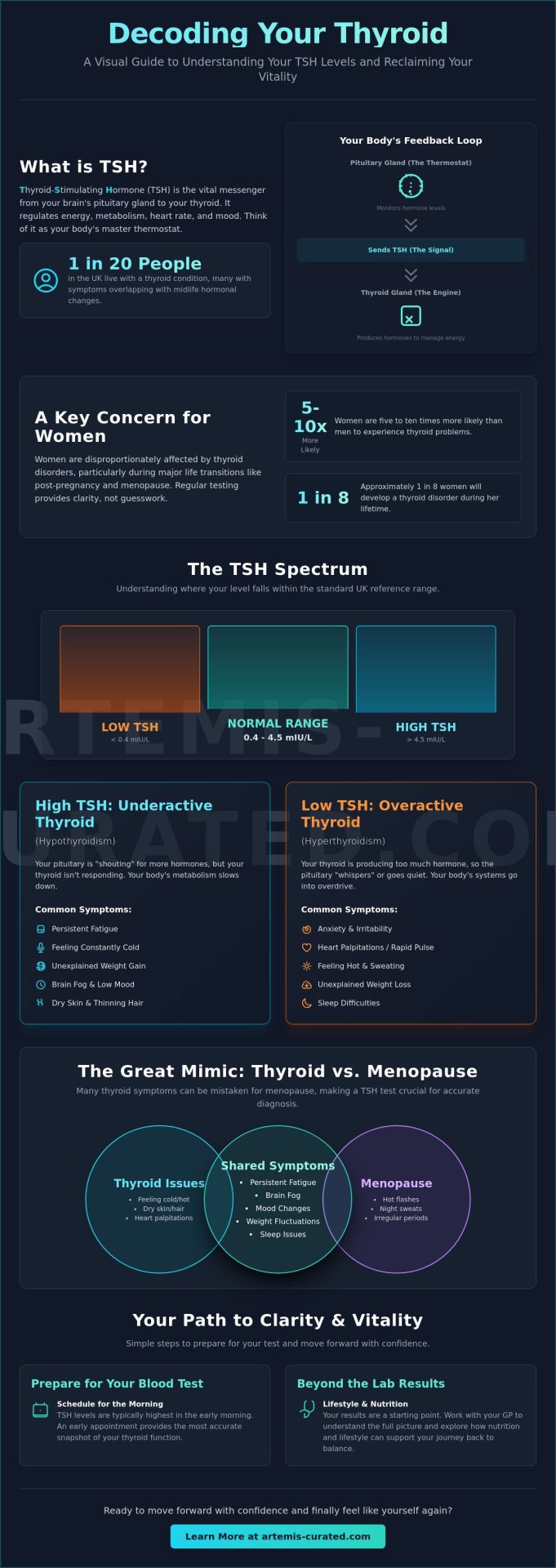
Have you ever wondered why you’re still feeling drained after ten hours of sleep, or why those extra pounds won’t budge despite your balanced diet? It’s exhausting to live in a state of constant fatigue, particularly when you’re already managing the shifts of menopause. According to the British Thyroid Foundation, approximately 1 in 20 people in the UK live with a thyroid condition, and these symptoms often overlap with midlife hormonal changes. Understanding your serum tsh level is the first step to discovering if your thyroid is the hidden reason your body’s natural rhythm feels out of sync.
Gaining this clarity can help you get back to better energy, a steadier mood, and a metabolism that actually works with you. This guide will help you decode your 2026 blood test results and provide a clear, helpful narrative for your next conversation with your GP. You’ll discover the intimate link between your thyroid and hormones, along with the practical steps needed to restore your sense of well-being. We’ll explore how to interpret the numbers so you can move forward with confidence and finally feel like yourself again.
Key Takeaways
- Learn how your serum tsh level acts as a vital messenger, signaling your thyroid to manage your energy and metabolism with precision.
- Navigate the standard UK reference ranges to understand whether your results indicate an underactive thyroid or a more complex hormonal shift.
- Uncover the connection between thyroid health and menopause, helping you distinguish between shared symptoms like brain fog and persistent fatigue.
- Prepare for your blood test with simple steps, such as timing your appointment for the early morning to capture your most accurate levels.
- Move beyond the lab result by learning how nutrition and intentional lifestyle choices can help you reclaim a sense of vitality and balance.
What is a Serum TSH Level and Why Does it Matter?
Your body is a sanctuary that deserves to be understood with depth and care. One of the most revealing ways to look inside is by checking your serum tsh level. TSH stands for Thyroid-Stimulating Hormone. It’s a chemical signal sent from your brain to the butterfly-shaped gland in your neck. You can imagine TSH as a messenger that tells your thyroid exactly how much energy to produce. A serum test involves measuring this hormone in the liquid part of your blood, providing a clear window into your metabolic rhythm. This matters because your thyroid regulates your heart rate, body temperature, and how efficiently you convert food into fuel. When this balance is off, you might feel a lingering fatigue or an unexplained shift in your mood.
The Pituitary Gland: Your Body’s Command Centre
The pituitary gland is a small but powerful organ located at the base of your brain. It functions as a vigilant sensor, monitoring the concentration of thyroid hormones in your system at all times. When these levels fall, the pituitary releases more Thyroid-stimulating hormone to prompt the thyroid to work harder. It’s helpful to think of this as a thermostat in a well-loved home. When the internal temperature drops, the thermostat signals the heating to start. Once the warmth returns to the desired level, the signal eases off. This feedback loop ensures your body maintains a steady, comfortable pace without you ever having to think about it.
Why Women are More Likely to Need a TSH Test
Thyroid health is a particularly intimate concern for women. Data indicates that women in the UK are significantly more prone to thyroid issues. According to the British Thyroid Foundation, women are five to ten times more likely than men to face these challenges. Around 1 in 8 women in the UK will develop a thyroid disorder during their lifetime. Life’s major transitions, such as the years following pregnancy or the onset of menopause, are common times for the thyroid to lose its steady rhythm. Testing your serum tsh level is a proactive way to care for yourself during these shifting chapters. It allows you to address symptoms like brain fog or weight changes with clarity rather than guesswork. For a deeper look at how your biology influences your well-being, visit our parent pillar on blood tests.
- Energy Management: TSH dictates how quickly you burn calories.
- Heart Health: It helps maintain a steady, healthy heart rate.
- Emotional Balance: Fluctuations can impact your daily mood and mental clarity.
Decoding the Results: What High and Low TSH Levels Really Mean
When you receive your blood test results, the number next to your serum tsh level can feel like a bit of a riddle. In the UK, most labs consider a range between 0.4 and 4.5 mIU/L to be standard. However, these boundaries aren’t set in stone. Different clinics might use slightly different benchmarks based on their specific equipment or the local population they serve. To get the full story, doctors usually look at TSH alongside Free T4 and Free T3. Think of TSH as the messenger and the T4/T3 as the actual workers. If you want a deeper dive into the mechanics, the TSH (Thyroid-stimulating hormone) Test guide offers a clear breakdown of why these markers matter.
Understanding Hypothyroidism (High TSH)
When your TSH is high, your pituitary gland is essentially screaming at your thyroid to wake up. It senses that there isn’t enough thyroid hormone in your system, so it pumps out more TSH to trigger production. This often leads to a sluggish feeling that permeates your whole day. You might notice persistent fatigue, a constant chill in your bones, or a dip in your mood. It also shows up in your physical appearance. Many people find their hair thinning or their skin becoming unusually dry and brittle. Supporting your body with targeted collagen support can help manage these external changes while you work on balancing your internal levels.
Understanding Hyperthyroidism (Low TSH)
A low TSH usually points toward an overactive thyroid, known as hyperthyroidism. In this state, your body is in overdrive because your thyroid is producing too much hormone. Your pituitary gland sees the surplus and stops sending signals, which is why the TSH drops. It feels like your internal engine is revving too high. Common signs include anxiety, heart palpitations, and losing weight without trying. This state often mimics that “wired but tired” feeling where you’re exhausted but your mind won’t stop racing. It’s a stressful cycle for your nervous system to endure, making it difficult to find moments of genuine rest.
The “Normal” Range vs. Optimal Health
There is a growing conversation around “subclinical” thyroid issues. This is when your serum tsh level is technically within that 0.4 to 4.5 range, but perhaps sitting right on the edge. You might still feel “off” even if your GP says your results are normal. Every body has its own unique rhythm. A level of 4.2 might be fine for one person but leave another feeling completely drained. It’s helpful to track how you feel alongside your numbers. If you’re looking for ways to bring more balance to your daily rituals, you can explore our curated collection of wellness essentials designed for a more intentional lifestyle. Focus on the narrative of your own health rather than just a digit on a page.
The Great Mimic: Why TSH and Menopause Symptoms Often Intertwine
Menopause and thyroid health are two distinct narratives that frequently share the same vocabulary. When you experience brain fog that makes words feel out of reach, or a sudden, unexplained shift in weight, it isn’t always clear which system is calling for attention. These symptoms are the hallmarks of both life stages. This overlap makes clinical clarity essential. Testing your serum tsh level is usually the first meaningful step in a menopause wellness journey. It allows you to distinguish between a natural hormonal transition and a thyroid that has lost its rhythm.
Distinguishing a hot flush from thyroid-related heat intolerance is a subtle art. A hot flush typically arrives as a sudden, intense wave of heat, often accompanied by a rapid heartbeat and followed by a chill. Thyroid-related heat intolerance is more of a constant, simmering discomfort. You might find yourself turning down the thermostat when everyone else is comfortable, or feeling a persistent inability to cope with warm environments. Data from the British Thyroid Foundation suggests that thyroid issues are ten times more prevalent in women, with many cases surfacing specifically during the perimenopausal years.
Oestrogen’s Influence on Your Thyroid
The relationship between oestrogen and your thyroid is intimate and complex. As oestrogen levels fluctuate during perimenopause, they impact a protein called thyroid-binding globulin (TBG). This protein acts as a carrier, moving thyroid hormones through your bloodstream. When oestrogen is high, TBG increases, which can “trap” more thyroid hormone and leave less available for your body to use. When oestrogen drops, the balance shifts again. These swings can make your serum tsh level appear stable on paper while you feel the physical effects of the fluctuation. Oestrogen levels directly regulate the production of thyroid-binding globulin, which dictates the amount of free thyroid hormone available for cellular function. This connection is why many women find their thyroid symptoms become much more noticeable as they approach their fifties.
Is it Menopause Fatigue or Thyroid Exhaustion?
Fatigue is a heavy word that carries different weights. To understand your own exhaustion, try tracking your energy with intentionality for 14 days. Note if your tiredness is a morning fog that never quite lifts, which often points toward the thyroid, or if it’s a result of the broken sleep and night sweats typical of menopause. Thyroid exhaustion often feels like a deep, leaden lethargy in the limbs that isn’t cured by a long weekend of rest. Conversely, menopause-related fatigue is frequently tied to the quality of your nocturnal environment. If you find your rest is consistently disrupted by temperature shifts, exploring the Art of Sleep can help you curate a more supportive space for recovery. Understanding these triggers helps you provide your GP with a clearer picture of your daily reality.
How to Prepare for Your Thyroid Blood Test in the UK
Preparing for a blood draw is a quiet act of self-care. To get an accurate reading of your serum tsh level, timing matters more than you might think. Your body follows a natural rhythm, and your hormones are part of that unfolding story. TSH levels typically reach their peak in the early hours of the morning, usually between 2:00 am and 4:00 am. By the time most UK clinics open at 8:00 am, those levels are beginning to dip. To capture the most useful data, you should aim to book your appointment for as early as possible, ideally before 9:00 am.
Fasting isn’t always a strict requirement for a TSH test alone. However, many GPs prefer you to arrive with an empty stomach if they’re also checking your glucose or cholesterol. It’s a good idea to check your specific instructions from the surgery at least 24 hours before you go. Consistency is your best tool for long-term health. If you’re retesting to monitor a condition, try to use the same laboratory and book the same time slot as your previous test. This ensures that the narrative of your health remains clear and comparable over time.
The Biotin Caution
Biotin, or Vitamin B7, is a silent disruptor in the world of thyroid testing. While it’s wonderful for supporting the strength of your hair and nails, it can significantly interfere with the laboratory equipment used to measure your serum tsh level. High doses can create a false picture, making it look like you have an overactive thyroid when you don’t. You should stop taking any biotin-containing supplements 3 to 5 days before your blood is drawn.
Common UK supplements that often contain high doses of biotin include:
- Holland & Barrett High Intensity Biotin (5000ug or 10000ug)
- Perfectil or Viviscal hair health ranges
- Boots Skin, Hair & Nails multivitamins
- High-strength B-complex tablets found in local pharmacies
Talking to Your GP About Your Results
Sometimes, a “normal” result on paper doesn’t match the reality of how you feel. It’s helpful to remember that the NHS reference range is a broad guide, not a definitive rule for every individual. If you feel unwell despite a standard result, don’t be afraid to advocate for yourself. You can ask for a full thyroid panel, which includes Free T4, Free T3, and thyroid antibodies. This provides a more detailed landscape of your endocrine health.
When you speak with your GP, you might try a gentle script like this: “I understand my serum tsh level is within the standard range, but I’m still struggling with fatigue and brain fog. Could we look at my T4 and T3 levels to see if they’re optimal for me?” It’s also vital to mention any family history. Since autoimmune thyroid conditions affect roughly 1 in 20 people in the UK, your genetic background is a crucial piece of the puzzle.
After your appointment, return to a space that feels like a sanctuary. You can find intentional pieces to help you rest and recover by exploring our curated collection of home essentials.
Beyond the Lab Result: Curating Your Path to Vitality
A lab report provides a helpful snapshot, but it isn’t the final word on your well-being. Your serum tsh level acts as a guidepost, showing you where you stand at a specific moment in time. However, the long-term narrative of your health is written by the small, intentional habits you practice every day. True vitality comes from looking past the numbers and focusing on how your body actually feels as you move through the world. It is about the quiet choices you make in your kitchen and the way you treat your mind during a busy afternoon.
Supporting your thyroid requires a thoughtful blend of key nutrients. Iodine, selenium, and zinc are the three pillars of thyroid health. In the UK, iodine levels can vary significantly across different diets, so incorporating white fish or organic dairy can be beneficial. Just two Brazil nuts daily offer a potent dose of selenium, while a handful of pumpkin seeds provides the zinc necessary for hormone synthesis. These aren’t just ingredients; they’re the building blocks of your inner harmony. When you nourish yourself with intention, you’re giving your thyroid the tools it needs to thrive.
The Role of Cortisol and Stress
High stress levels create a ripple effect throughout your entire endocrine system. When you’re constantly in “fight or flight” mode, your body produces excess cortisol. This hormone can actually suppress your serum tsh level and prevent your thyroid from working at its best. It’s a protective mechanism that can leave you feeling exhausted and depleted. Finding ways to lower stress doesn’t have to be complicated or expensive. Short periods of restorative rest or gentle, mindful movement can signal to your brain that it’s safe to relax. You can find more detailed strategies in this cortisol guide which explores how to master your internal rhythm and find peace.
Nurturing Your Body Through the Transition
Focusing on whole, unprocessed foods gives your metabolism the steady energy it craves. Instead of looking for a quick fix, think of your health as a gathering of positive choices. This includes choosing gentle movement, like a walk through a local park, that builds strength without leading to burnout. A curated approach to supplements can also play a supportive role in maintaining your hormonal balance. Ultimately, you’re the expert on your own experience. By paying attention to your energy levels and mood, you can adjust your habits to suit your unique needs. Trust your intuition as you curate a life that feels both balanced and vibrant.
Taking the Next Step for Your Wellbeing
Navigating your health journey doesn’t have to feel like a chore. Your serum tsh level provides a vital window into how your body is functioning, but it’s only one chapter of your story. Since thyroid fluctuations and menopause often share the same symptoms, getting a clear picture is essential. Research shows that TSH levels can vary significantly throughout the day, so aim for a blood test before 10:00 AM for the most reliable results. This simple bit of timing helps you and your doctor make informed decisions about your care.
True vitality comes from looking at the whole picture rather than just a lab report. If you’re looking for a more intentional way to support your body, we’re here to help. Our collections are formulated for the unique needs of women over 40. We focus on holistic hormonal balance and ensure every product is free from unnecessary fillers and synthetic additives. It’s about choosing quality that respects your body’s natural rhythm.
Explore the Art of Harmony: Curated Support for Your Menopause Journey
You deserve to feel like yourself again. Take things one day at a time; remember that small, intentional choices lead to the most lasting changes.
Frequently Asked Questions
Can I take my thyroid medication before a TSH blood test?
You should wait until after your blood sample is taken before you take your daily thyroid medication. Taking your dose right before the test can cause a temporary spike in hormone levels, which might lead to an inaccurate reading of your thyroid function. Most GP surgeries in the UK recommend scheduling your appointment for early morning, usually before 10:00 AM, to ensure your serum tsh level is measured at its natural baseline.
How often should I have my TSH levels checked during menopause?
It’s a good idea to have your levels checked once every 12 months during menopause, or sooner if you notice new symptoms like unexpected weight gain or persistent fatigue. Since the symptoms of menopause and thyroid dysfunction often mirror each other, regular screening helps your doctor distinguish between the two. About 1 in 10 women over the age of 50 will develop a thyroid issue, making annual checks a sensible part of your health routine.
What is a “normal” TSH level for a woman over 50 in the UK?
A normal TSH level for a woman over 50 in the UK typically falls between 0.4 and 4.5 mIU/L. While these are the standard reference ranges used by most NHS laboratories, your doctor might look for a more specific range based on your personal health history. If your result sits outside these figures, it usually triggers a follow-up test for T4 to get a clearer picture of your metabolic health.
Can stress cause my TSH levels to fluctuate?
Significant physical or emotional stress can cause your TSH levels to fluctuate. When your body produces high amounts of cortisol, it can interfere with the delicate signals between your brain and your thyroid gland. This doesn’t mean you have a permanent disease; it’s often a temporary reaction to your environment. If you’ve had a particularly difficult month, it’s helpful to mention this to your clinician before they interpret your results.
Does biotin really affect my thyroid test results?
Biotin can definitely interfere with your thyroid test results, often making a healthy thyroid appear hyperactive when it isn’t. Most UK laboratories advise that you stop taking any supplements containing more than 5mg of biotin at least 48 to 72 hours before your blood draw. This ensures the laboratory equipment can accurately measure your serum tsh level without the vitamin masking the real data of your hormonal health.
What happens if my TSH is normal but my T4 is low?
If your TSH is normal but your T4 is low, it might indicate a rare condition called central hypothyroidism. This happens when the pituitary gland isn’t sending enough signals, even though the thyroid itself is capable of working properly. It’s an uncommon finding that affects roughly 1 in 20,000 people in the UK. Your doctor will likely refer you to an endocrinologist to investigate the cause of this specific balance.
Can I improve my TSH levels naturally through diet?
You can support your thyroid through your diet, but food alone rarely fixes a clinical imbalance that requires medication. Focus on getting the recommended 142 micrograms of iodine daily through sources like white fish, eggs, or dairy. Including two Brazil nuts a day provides about 70 to 100 micrograms of selenium, which is a vital mineral for hormone conversion. These small choices help create a steady foundation for your endocrine system to function well.
Is a serum TSH test different from a finger-prick home test?
A serum TSH test is different from a home finger-prick test because it uses a larger volume of blood taken directly from a vein. While home kits are convenient for quick checks, venous samples are less prone to contamination and provide more consistent results in a clinical setting. Most NHS specialists prefer the accuracy of a venous draw when they’re making a formal diagnosis or adjusting your medication dosage for the long term.