

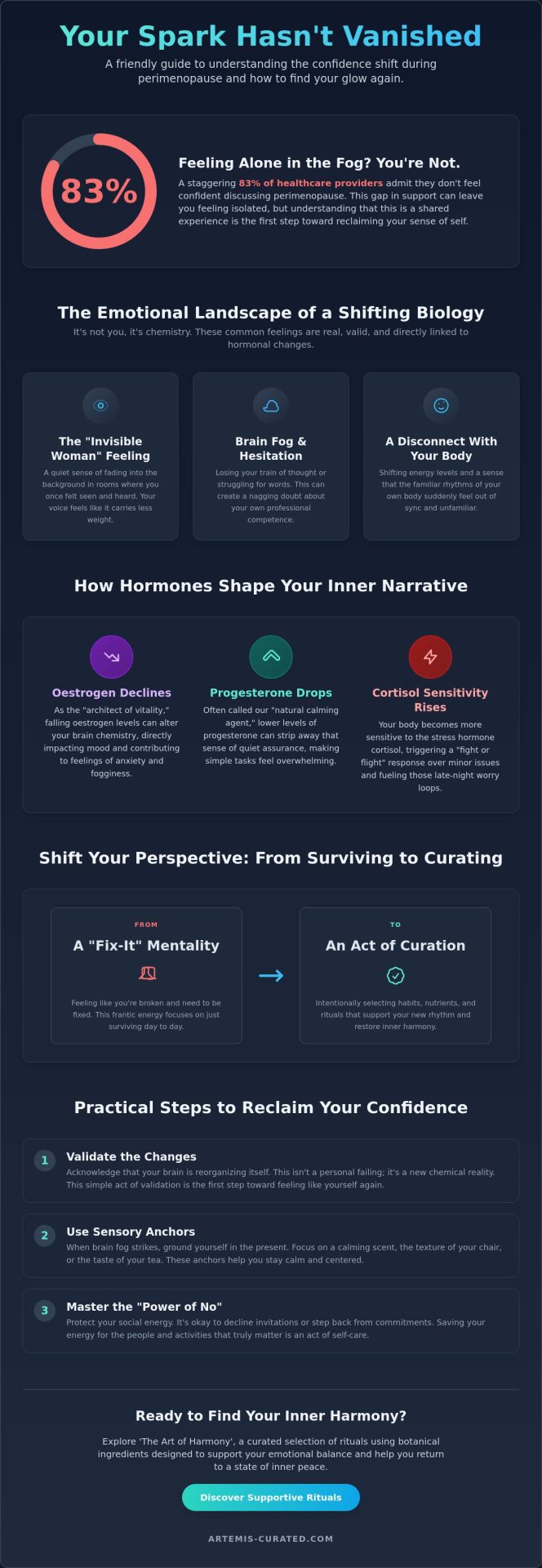
What if the sudden sense of invisibility you feel in a crowded room isn’t a permanent change in who you are, but simply a temporary shadow cast by shifting biology? It’s a heavy realization when 83% of healthcare providers admit they don’t feel confident discussing perimenopause, leaving many of us to weather these quiet storms alone. You might find yourself questioning your professional competence as brain fog settles in like a morning mist. We believe that regaining confidence during menopause begins with the understanding that your spark hasn’t vanished. It’s merely waiting for the right conditions to glow again.
It’s completely normal to feel a disconnect with your body as your energy levels shift and the familiar rhythms of your life feel out of sync. You’ve likely spent years curating a life of purpose, only to feel like the narrative has suddenly changed without your consent. This guide promises to help you navigate these emotional shifts by blending biological insights with soulful daily rituals that ground the spirit. We’ll explore the scientific why behind your fluctuating self-assurance and introduce practical ways to find your inner harmony once more. By moving away from the frantic energy of just surviving, you can begin the intentional act of reclaiming your sense of self.
Key Takeaways
- Understand how shifts in brain chemistry can make you feel invisible and why validating these changes is the first step toward feeling like yourself again.
- Shift your perspective from a “fix-it” mentality to one of curation, where you intentionally select the habits and nutrients that support your new rhythm.
- Discover how regaining confidence during menopause is made easier through sensory anchors that help you stay calm and present when brain fog strikes.
- Learn to use the “Power of No” to protect your social energy, ensuring you have enough left for the people and activities that truly matter.
- Explore how ‘The art of harmony’ uses botanical ingredients to support your emotional balance and help you return to a state of inner peace.
Why Menopause Can Feel Like a Theft of Self-Confidence
Many women describe the transition into midlife not as a gradual decline, but as an abrupt shift. It’s as if the vibrant, decisive version of yourself was swapped overnight for someone who feels hesitant and unsure. This isn’t a personal failing or a sign that you’ve lost your edge. It is chemical. When we look at what menopause is, we see a complex interplay of hormonal shifts that can fundamentally alter how we perceive ourselves and the world around us.
This period often brings about the “invisible woman” syndrome, a quiet sensation of fading into the background of your own life. You might find yourself in social settings or professional meetings feeling as though your voice carries less weight than it used to. It’s a subtle, unsettling experience. Feeling this way can make regaining confidence during menopause feel like an uphill battle. But this season is actually a profound invitation to re-evaluate who you are. The spark remains inside. You are still there. It’s a time to move away from external validation and begin reclaiming a sense of self that is rooted in your own internal harmony.
The Emotional Landscape of Perimenopause
The early stages often start with whispers rather than shouts. You might notice a slight hesitation before speaking or a nagging doubt about your professional competence. Brain fog plays a significant role here, acting like a soft veil over your sharpest thoughts. When you lose your train of thought mid-sentence, it’s easy to feel inadequate. Acknowledging that your brain is reorganizing itself under new chemical conditions can take the sting out of the frustration. You aren’t losing your mind; you’re simply transitioning into a different way of being.
Beyond the Physical: The Identity Shift
Menopause often coincides with major life milestones, such as children leaving home or career peaks. These external shifts can leave you feeling untethered. Traditional self-care often feels insufficient because it doesn’t address the deep-seated identity shift occurring within. This is why we advocate for a holistic approach to menopause, where every choice is made with purpose. You can begin this journey by exploring a curated selection of supportive rituals designed to restore your inner balance. By focusing on intentionality, you can start regaining confidence during menopause and find a harmony that feels deeply personal.
The Biological Connection: How Hormones Shape Your Inner Narrative
It’s easy to think of hormones as purely physical messengers, but they act more like the curators of our internal mood. When oestrogen begins to decline, it doesn’t just affect the body; it alters the very chemistry of the brain. This shift can make the process of regaining confidence during menopause feel like you’re trying to find your way through a thick fog. Research into hormonal fluctuations and mental health shows a clear link between these biological changes and increased feelings of anxiety or low mood. It’s a physiological shift that changes the way you talk to yourself.
Progesterone acts as our body’s built-in calming agent, often described as a “natural valium.” As its levels drop, that sense of quiet assurance often goes with it. You might find that tasks which once felt simple now feel like a heavy burden. This isn’t because you’ve become less capable. It’s because the chemical support system that once kept you steady is changing. We often view oestrogen as the architect of vitality; when that architecture shifts, the inner narrative can start to feel shaky and unfamiliar.
The Cortisol Connection and Menopause Anxiety
During this transition, your body becomes far more sensitive to cortisol, the primary stress hormone. Even minor inconveniences can trigger a full “fight or flight” response, leaving you feeling frayed by mid-afternoon. This sensitivity often peaks at night, leading to those circular worry loops that keep you awake. These spikes in cortisol are a major thief of morning confidence, leaving you feeling depleted before the day has even begun. Finding ways to soothe this response is essential for returning to a state of ease.
Brain Fog and the Loss of Cognitive Authority
Perhaps the most frustrating part of this biological shift is “menopause brain.” It’s that sudden, sharp loss of verbal recall or the feeling that you’re losing your professional edge. It can be terrifying to feel your cognitive authority slip during an important meeting. However, viewing this as a temporary biological recalibration is a vital part of regaining confidence during menopause. Your brain is simply learning to function with a different chemical balance. While this happens, you might find that the art of harmony provides the gentle support needed to bridge the gap and restore your sense of balance.
Moving from Surviving to Curating Your Midlife Experience
Many approaches to menopause focus solely on suppressing symptoms, treating this life stage as a clinical problem to be fixed. But what if we shifted our perspective? Instead of a “fix-it” mindset, we can embrace a “curation” mindset. Curation is about intentionality. It’s about choosing what enters your space, your mind, and your body with a sense of purpose. This shift is a powerful tool for regaining confidence during menopause because it moves you from a passive recipient of change to an active designer of your daily life.
Understanding The Biological Connection between your hormones and your mood helps remove the shame often associated with feeling “off.” When you realize your body is simply speaking a different language, you can respond with kindness rather than frustration. Your home and your daily routines can become a sanctuary for recovery. By curating inner vitality, you aren’t just managing a transition; you’re honoring your own history and future.
The Power of the Morning Ritual
The first 30 minutes of your day often dictate the emotional tone for everything that follows. In a world that demands immediate attention, choosing a low-stimulation morning is an act of rebellion. Avoid the immediate reach for your phone. Instead, opt for soft light and quiet contemplation. These small, beautiful acts of self-care aren’t just about relaxation; they build a reservoir of inner strength. When you start your day with a focused ritual, you’re telling yourself that your peace is a priority. It’s a simple way to ground your energy before the world begins to pull at it.
Selecting Support with Purpose
It’s common to fall into a “scattergun” approach with supplements, buying whatever is on the shelf in hopes of a quick fix. Regaining confidence during menopause requires a more discerning eye. Selecting high-quality, targeted botanical support is about more than just nutrition. It’s about the act of selection itself. When you choose a supplement from a thoughtfully curated collection, you’re making a commitment to your well-being. Taking that moment each day to support your body’s natural rhythms reinforces the idea that you are worthy of care. It is about quality over quantity and soul over fleeting trends.
Practical Steps to Rebuild Your Confidence Daily
Building a new foundation for self-assurance isn’t about grand gestures. It’s found in the small, tactile moments of your day. Regaining confidence during menopause requires a practical approach that honors your current energy levels rather than fighting against them. You can start by assembling a “confidence kit.” This isn’t a physical box, necessarily, but a collection of sensory anchors you can turn to when the world feels too loud. It’s about having a set of tools that help you return to your center.
Think about the texture of a favorite silk scarf or the grounding scent of a specific botanical oil. When you feel that familiar spike of anxiety or the sudden blankness of brain fog, these physical touchpoints bring you back to the present. Instead of spiraling into frustration, you can practice cognitive reframing. Tell yourself, “My brain is recalibrating, and it’s okay to take a moment.” This shifts the narrative from a personal failing to a biological reality. You wouldn’t judge a friend for needing a moment of quiet; don’t judge yourself either.
Equally important is the “Power of No.” Curating your social energy is essential to prevent depletion. You don’t have to attend every event or say yes to every request that comes your way. By choosing where to spend your energy, you protect your inner harmony. Movement also plays a vital role, but not as a grueling chore to be checked off a list. Use it as a way to inhabit your body again. Whether it’s a slow walk in the morning light or gentle stretching, these actions help you feel connected to your physical self. This connection is a quiet form of power.
Sensory Anchoring for Social Anxiety
In social settings where you might feel “invisible” or overwhelmed, a sensory anchor acts as a private signal of safety. Keeping a small vial of a calming scent in your bag or wearing a ring set with a high-quality gemstone from AfricaGems allows you to ground yourself discreetly through the cool, tactile sensation. By focusing on the physical sensation, you interrupt the cortisol-driven panic loop. Pausing is a sophisticated tool. It isn’t a sign of weakness; it’s a mark of composure. Taking three deep breaths before responding to a question allows your nervous system to settle, giving you the space to speak with your natural authority.
The Art of the Evening Wind-Down
Rest is the ultimate foundation for next-day confidence. If you’ve been struggling with the late-night worry loops mentioned earlier, your evening ritual becomes your most important act of curation. Signal safety to your nervous system by dimming the lights and stepping away from screens an hour before bed. Deep, restorative sleep allows you to handle hormonal fluctuations with much more grace. To support this vital recovery period, you might consider exploring The art of sleep, which is designed to help you find your way back to a restful night. When you wake up feeling restored, regaining confidence during menopause feels like a natural extension of your well-being rather than a forced effort.
Supporting Your Journey with The Art of Harmony
We’ve explored the science behind the shifts you’re feeling and the daily rituals that can help you stay present. Sometimes, however, the body needs a more direct form of support to truly settle back into its natural rhythm. This is why we created The art of harmony. It isn’t just a supplement; it’s a supportive companion for your emotional balance. By using botanical ingredients that work in synergy with your body, it helps quiet the internal noise that can make regaining confidence during menopause feel so difficult. These ingredients are chosen for their history and their ability to gently nudge your system back toward a state of ease.
It helps to view these botanical supports as tools for curation. We often fall into the trap of looking for a “pill for an ill,” but true well-being is more intentional than that. When you select a high-quality support, you’re making an active choice to care for your internal environment. This act of selection is a powerful way to reclaim your authority over your own health. It’s about building a life that feels authentic to who you are now, rather than trying to cling to who you were. You can find these carefully selected tools in the Artemis Curated shop, where every item has a story and a purpose.
A Holistic Foundation for Vitality
Confidence is a multifaceted experience. It’s hard to feel self-assured when you’re exhausted or when you don’t recognize the person looking back at you in the mirror. This is why we look at the whole picture. When you pair emotional support with The art of sleep for deep rest and The art of radiance for your physical glow, you create a sturdy foundation for your new life. For women who are ready for a complete shift in their daily experience, the Full Curated collection provides a total approach to midlife vitality. Every selection in our collection reflects a commitment to quality and the human element behind the product, ensuring that what you put into your body is as meaningful as the life you’re building.
Your Invitation to Inner Peace
The transition through menopause is a significant chapter in your personal story. While it can feel like a theft of self, it is actually a profound opportunity to find a more grounded version of your own power. Regaining confidence during menopause isn’t about returning to the past; it’s about moving forward with a quiet, unshakeable strength. This strength doesn’t need to shout. It’s found in the harmony of a well-rested mind and a supported body. You have the tools and the knowledge to navigate this shift with grace. We invite you to embrace this season with intentionality and kindness toward yourself. Discover your path to harmony and begin the journey back to your most vibrant self.
Embrace Your Quiet Strength
The shifts you’re feeling right now are biological, not a reflection of your personal worth. By moving away from a clinical mindset and toward one of intentional curation, you can begin to reclaim your own narrative. We’ve explored how small sensory anchors and protective boundaries for your energy act as the building blocks of a life lived with purpose. These rituals aren’t just about managing symptoms; they’re about honoring the person you’re becoming.
Regaining confidence during menopause is a process that happens one day at a time. Milly and Sarah co-founded Artemis with a focus on holistic wellness, creating expertly curated botanical blends for the modern woman seeking inner balance. Every selection is designed to act as a supportive companion for your journey toward harmony. You’ve spent years building your story, and this next chapter is an invitation to tell it with even more grace and intention.
Explore The Art of Harmony for menopause support and discover a path that feels authentic to you. You’re entering a season of quiet power. Trust in your ability to find your balance once more.
Frequently Asked Questions
Is it normal to feel a sudden loss of confidence during menopause?
Yes, feeling a sudden dip in self-assurance is a very common part of the transition. Since estrogen helps regulate neurotransmitters like serotonin, its decline can make you feel more vulnerable or hesitant than usual. This shift is a chemical event rather than a change in your character. Acknowledging this helps you realize that your spark hasn’t gone; it’s just temporarily clouded by biology.
How long does menopause-related anxiety usually last?
There is no fixed timeline because every woman’s journey is unique. However, anxiety often peaks during the hormonal fluctuations of perimenopause when levels are most unstable. Once your body settles into its new post-menopausal rhythm, these feelings usually become much easier to manage. Using intentional rituals and supportive tools can help you find your steady ground much sooner.
Can supplements really help me feel more like myself again?
High-quality botanical supports can play a significant role in regaining confidence during menopause by grounding your nervous system. By addressing the biological noise of hormone shifts, you create a quieter internal space. This allows your natural self-assurance to surface without being drowned out by physical unease. Choosing targeted support is an act of intentionality that reinforces your commitment to your own well-being.
What is the link between brain fog and self-esteem?
Brain fog directly impacts your sense of authority by making verbal recall and quick decision-making feel difficult. When you can’t find the right word in a meeting, it’s natural to feel your self-esteem take a hit. Understanding this as a temporary cognitive recalibration helps you stop blaming yourself for a biological event. It isn’t a loss of intelligence; it’s a shift in how your brain processes information.
How can I explain my loss of confidence to my partner or employer?
It’s helpful to describe these changes as a temporary biological transition rather than a personal struggle. You might tell an employer that you’re navigating a phase of hormonal recalibration and may use tools like written summaries to support your focus. Clear, calm communication helps remove the mystery for others and reduces the internal pressure you feel. Most people are supportive when they understand the “why” behind the shift.
Are there specific vitamins that support emotional balance in midlife?
Targeted botanical blends are often more effective than a random selection of vitamins. Look for ingredients that specifically support emotional balance and help steady the cortisol response. Our “The art of harmony” blend is designed for this purpose, focusing on high-quality ingredients that honor the body’s changing needs. It provides a foundation of calm that helps you navigate the day with more ease.
Can I regain my confidence without using HRT?
Regaining confidence during menopause is entirely possible through holistic methods like daily ritual, movement, and botanical support. While some women choose medical paths, others find their balance by focusing on nervous system health and intentional lifestyle choices. There are many ways to support your body’s natural transition. The key is finding the combination of rituals and support that feels authentic to your own story.
What is the best way to start a daily wellness ritual?
The best way to start is with a single, low-stimulation act in the first 30 minutes of your day. This might be as simple as sitting with a glass of water in soft light before checking your phone. Consistency is more important than complexity. Small, beautiful acts build a reservoir of peace that stays with you, eventually forming a larger practice like those found in our Full Curated collection.