

What if the distance growing between you and your partner isn’t a loss of love, but a simple lack of vocabulary? It’s a heavy feeling when you realize that 64% of women report physical and mental exhaustion during this transition, yet many of us still struggle with how to explain menopause to my partner. You might feel invisible or even a bit “crazy” as your body shifts. Your partner watches from the sidelines. They’re often unsure of how to help or when to step in. A shift in rhythm. A new way of being together.
I understand how draining it is to search for the right words when you’re already managing hot flashes or joint discomfort. You deserve to feel seen and supported in the life you’ve built. This guide will help you bridge the communication gap and transform this personal journey into a shared path toward wellness. We’ll explore how to start honest conversations, create a mutual plan for harmony, and rediscover the connection that makes your home a peaceful haven.
Key Takeaways
- Understand why menopause is a transition for your whole home, not just for you. Speaking openly helps your partner feel included instead of pushed away.
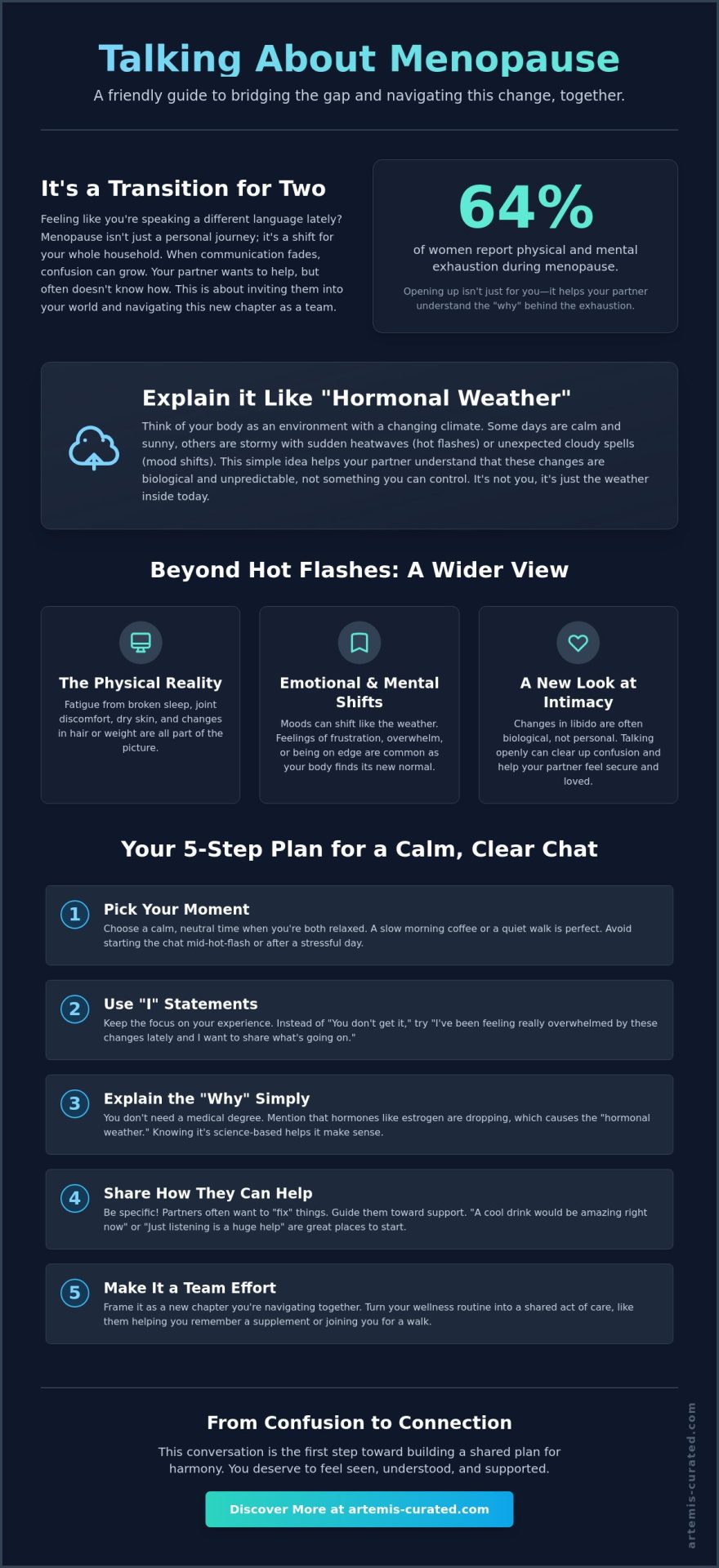
- Learn how to explain menopause to my partner by describing your symptoms as “hormonal weather.” This simple language helps them grasp the physical and emotional shifts you’re feeling.
- Clear up any confusion about intimacy and attraction. You’ll find out how to talk about the biological reasons for changes in libido so your partner feels secure.
- Follow a five-step plan for a calm, productive talk. This approach helps you explain the science of estrogen and progesterone drops without the stress.
- Turn your wellness routine into a shared act of care. Discover how your partner can help with your supplement schedule to create a more supportive atmosphere.
Why Opening Up About Menopause is the First Step to Harmony
Menopause often feels like a solo climb, but the truth is your partner is in the base camp watching the weather change without a map. When you stop talking about what’s happening, a quiet gap begins to grow between you. Your partner might see you withdraw or notice your frustration and assume they’re the cause. This silence isn’t just lonely for you; it’s confusing for them. Learning how to explain menopause to my partner is less about delivering a medical lecture and more about inviting them back into your world. It’s a way to reclaim the natural rhythm of your relationship.
It’s completely normal to feel a bit of hesitation here. You might worry that your partner will judge you, or perhaps you fear they’ll think you’re just complaining. These feelings are valid. After all, your body is changing in ways that feel unpredictable even to you. However, keeping these shifts a secret usually creates more tension than the truth ever could. When you open up, you transform a private struggle into a shared household transition. You aren’t just “going through something” alone; you’re navigating a new chapter of life as a team.
Breaking the Silence Gently
Timing is everything when you decide to have this talk. Don’t start the conversation when you’re in the middle of a sudden hot flash or right after a long, exhausting day at work. Those “hot moments” are rarely productive. Instead, choose a neutral time when you both feel relaxed and connected. A quiet walk or a slow morning coffee works well. Use “I” statements to keep the focus on your personal experience. Instead of saying “You don’t understand what I’m dealing with,” try “I’ve been feeling really overwhelmed by these physical changes lately and I’d love to share what’s going on.” This keeps the energy calm and prevents your partner from feeling attacked.
The Goal: Moving from Confusion to Connection
Success in these conversations isn’t about finding an overnight cure or a perfect solution. It’s about feeling seen and building a support plan together. You want to shift the dynamic from your partner trying to “fix” you to both of you supporting the journey. It helps to share a comprehensive overview of menopause so they understand that these biological shifts are grounded in science. For instance, explaining the vital role of oestrogen can help them see why your energy, skin, or mood might fluctuate so much. When your partner understands the “why” behind the symptoms, they can stop guessing and start offering the specific kind of care you actually need.
What Your Partner Needs to Know: The ‘Hormonal Weather’ Explained
When you’re considering how to explain menopause to my partner, it’s helpful to describe your body as an environment experiencing a total shift in climate. Perimenopause is the long, often stormy transition period where your hormones begin their slow retreat. Menopause is the destination, marked officially when you’ve gone twelve months without a period. This isn’t a medical event that happens once; it’s a profound biological recalibration. Using the idea of internal weather helps your partner understand that a sudden mood shift or a flash of heat isn’t something you can control. It’s just the current conditions of the day. These changes are deeply biological, rooted in your DNA and chemistry, rather than being a personal choice or a reflection of your lifestyle.
According to the National Institute on Aging, these fluctuations lead to a variety of common symptoms of menopause that ripple through your physical, emotional, and cognitive life. It’s a lot to manage at once. For your partner, seeing these as a series of biological facts can remove the mystery and the fear that often leads to withdrawal.
The Physical Reality: Beyond Hot Flushes
While most people associate this time with hot flashes, the physical reality is much broader. A 2024 global analysis found that 64.13% of women report physical and mental exhaustion. This fatigue is often driven by broken sleep; if you aren’t resting, your daily energy and patience naturally thin out. This is also where cortisol plays a major role. When your hormones are in flux, your stress response can become more sensitive, leading to weight changes or a feeling of being constantly on edge. You might also notice your skin feels drier or your hair loses its usual luster, which can affect how you feel in your own space.
The Emotional Shift: Why Your ‘Fuse’ Might Be Shorter
The emotional landscape of menopause can feel like a loss of control. When oestrogen and progesterone levels drop, they take the brain’s “feel-good” chemicals with them. This is why your fuse might feel shorter than it used to. It’s vital to reassure your partner that your irritability isn’t a reflection of your feelings for them; it’s a side effect of your chemistry being out of balance. Cognitive changes, often called brain fog, can also make you feel forgetful or less sharp. Explaining this helps your partner realize that when you lose your keys or forget a detail, it’s a symptom, not a lack of care. Finding a sense of balance can start with small, intentional choices, like exploring curated support for your daily rhythm.
Addressing the Elephant in the Room: Changes in Intimacy
It is often the most delicate part of the conversation. When the physical closeness that once felt effortless begins to shift, silence can be interpreted as a loss of interest. Your partner might secretly worry that you’re no longer attracted to them. When you’re figuring out how to explain menopause to my partner, you have to address this head-on. It isn’t about a lack of love; it’s about a significant change in your biological landscape. Lower levels of hormones can lead to physical discomfort or a simple drop in drive. By framing this as a shared challenge rather than a personal failing, you reassure them that the spark hasn’t vanished. You’re simply learning a new way to be together.
Intimacy is a broad spectrum that covers far more than just the physical act. It’s about the safety of being known and the comfort of being seen. Approaching this as a team helps remove the pressure from both of you. Instead of focusing on what might be missing, you can focus on rediscovering what feels good right now. This shift in perspective turns a potential source of tension into an opportunity for deeper emotional connection.
Explaining Libido as a Biological ‘Volume Dial’
Think of your libido like a biological volume dial. For years, that dial might have been set to a steady level, but right now, your hormones have turned it down. It doesn’t mean the music has stopped playing. In the past, desire might have been a quick spark, but now it requires more kindling. This kindling comes in the form of deep rest, lower stress, and feeling emotionally supported. When you’re navigating menopause, your body is working overtime just to maintain balance. Helping your partner understand that “the mood” is now tied to your overall energy levels makes a world of difference. It moves the conversation from performance to partnership.
Finding New Ways to Connect
On weeks when physical desire feels out of reach, you can still build a sense of closeness through small, intentional rituals. This is where the concept of the art of passion becomes a holistic pursuit. It’s about cultivating a life that feels vibrant and connected, even when your body feels tired. Suggest non-physical ways to stay close, like a shared walk at dusk or simply sitting together without the distraction of phones. Commit to total honesty when you’re just not “in the mood” due to fatigue. Saying “I love being near you, but I’m physically exhausted” is much clearer than staying silent. This simple clarity prevents the confusion that often leads to partners feeling pushed away.
Five Steps to a Clear and Calm Conversation
Starting a conversation about how to explain menopause to my partner shouldn’t feel like a confrontation. Think of it as an invitation to a deeper level of understanding; it’s a chance to build a shared map of this new territory together. When you approach the talk with clarity, you remove the guesswork that often leads to silence and tension. Here is a simple, five-step approach designed to keep the energy calm and the connection strong.
- Step 1: Share a ‘state of the union’. Be honest about your current symptoms. Mention that you’re part of the 64% of women experiencing physical and mental exhaustion. It grounds your personal experience in a verified, global reality.
- Step 2: Explain the ‘Why’. Use simple science to anchor the discussion. Tell them that your oestrogen and progesterone levels are dropping. These hormones are the architects of your daily balance; when they shift, the whole structure of your day can feel a bit unstable.
- Step 3: Be specific about support. Vague requests for “help” are difficult to follow. Instead, be precise. Say, “I need 20 minutes of quiet when I first get home,” or “I need you to handle the grocery shopping this month.”
- Step 4: Invite questions. Give your partner space to be curious. If they ask something, it’s usually because they want to support you better. Try not to feel defensive; they are simply trying to learn your new rhythm.
- Step 5: Agree on a shorthand signal. Pick a simple word or a gesture for those days when you’re feeling completely overwhelmed. it lets them know to give you grace and space without you having to find the energy for a long explanation.
Practical Scripts You Can Use
Sometimes the hardest part is finding the first few words to describe an invisible feeling. To describe brain fog, you might say: “My brain feels like a browser with too many tabs open right now.” It’s a relatable way to explain why you might be forgetful or distracted. For those sudden mood shifts, try: “I’m feeling very reactive today; it’s the hormones, not you.” This simple reassurance prevents your partner from taking your frustration personally. You can also encourage them to check in with a gentle, daily question like, “How is your weather today?” This allows you to give a quick update on your internal state without any pressure.
Inviting Them to Be Part of the Solution
Your partner likely wants to be helpful but may not know where to begin. Ask for assistance with specific household tasks that trigger your stress, such as loud chores or managing a complex social calendar. You can also invite them to learn about the intentional choices you’re making for your wellness. Suggest they read a guide on the best supplements for women so they understand the science behind your routine. When wellness becomes a shared interest rather than a solo chore, it creates a sense of sanctuary in the home. To begin curating your shared plan for harmony, you can explore our full collection of support here.
Creating a Shared Sanctuary: Rituals for Menopause Support
Once you’ve navigated the initial talk about how to explain menopause to my partner, the focus shifts to the daily rhythm of your home. It’s about more than just patience; it’s about curating a lifestyle that supports your hormonal balance. Think of your home as a sanctuary where every choice is intentional. Your partner can play a beautiful role here. Instead of just watching you manage symptoms, they can help build the rituals that make life feel smoother. Maybe it’s dimming the lights an hour before bed or ensuring the bedroom stays cool for a better night’s rest. These small acts of care turn a difficult transition into a shared project of wellness.
A calm environment is essential for lowering stress and improving the quality of your sleep. When the atmosphere of your home is quiet and supportive, your body has a better chance to recalibrate. You might find that the habits you build now, like a slow evening walk or a screen-free hour, become the most cherished parts of your day. Menopause is a temporary storm, but the healthy habits you create together will last for years to come. It’s a chance to refine your life, choosing quality over quantity and peace over the frantic pace of the outside world.
The Role of Targeted Wellness
Supporting your body through this shift requires a thoughtful approach to what you put into it. This is where your partner can truly step in. They can support your routine by helping you stay consistent with your choices. For example, “The Art of Harmony” is designed specifically for menopause support, helping you find your daily equilibrium. Since sleep is the foundation of your mood and energy, your partner can help by prioritizing a restful environment alongside “The Art of Sleep.” You can even sit down together and browse the Artemis Curated shop to look at support options that fit your specific needs. Making these selections together turns your wellness journey into a shared act of care.
A New Chapter of Shared Health
This transition is a unique opportunity to get healthier as a couple. When you’re open about what you need, it encourages your partner to think about their own wellness too. The right support makes the journey much smoother and less lonely. You aren’t just managing a list of symptoms; you’re entering a new chapter of life with a deeper level of connection. By focusing on intentionality and mutual support, you can transform this time into a period of growth and harmony. We invite you to explore our full collection to find the perfect support for your total wellness and continued connection.
Embracing a New Rhythm Together
Your home should be a sanctuary where you feel fully seen and understood. By following these steps, you’ve begun the vital work of bringing your partner into your journey with clarity and grace. Remember that moving from silence to connection is a practice, not a one-time event. Whether you’re describing the “hormonal weather” or setting firm boundaries for your rest, you’re building a foundation of mutual respect that will carry you through this transition.
Learning how to explain menopause to my partner is the first step toward reclaiming your shared peace. It transforms a private struggle into a collaborative path toward wellness. To support your body during this shift, we invite you to Explore The Art of Harmony for daily menopause support. These expertly curated botanical blends provide no-nonsense, natural support for UK women, focusing on holistic harmony for both mind and body. This transition doesn’t have to be a period of withdrawal. Instead, let it be the moment you and your partner discover a new, more intentional way of living together. You have the tools to navigate this with confidence.
Frequently Asked Questions
How do I explain menopause to my husband without him getting defensive?
The best way to prevent defensiveness is to choose a calm, neutral moment for the talk and use “I” statements. Focus on describing your physical feelings rather than critiquing his actions or reactions. When you’re learning how to explain menopause to my partner, it helps to frame the discussion as a shared journey toward household harmony. Reassure him that these changes are a biological recalibration and not a reflection of your feelings for him.
What is the best way to describe menopause brain fog to someone who hasn’t felt it?
You might describe it as having a dozen browser tabs open at once while the Wi-Fi is lagging. It isn’t a loss of intelligence; it’s a temporary dip in processing speed and recall caused by shifting hormones. Explain that sometimes your thoughts feel like they’re behind a thin veil of mist. This helps your partner understand why you might lose your keys or forget a detail in a conversation without assuming you’re being careless.
Can I show my partner a list of symptoms to help them understand?
Sharing a list of common symptoms from a reputable source can be incredibly helpful for both of you. It moves the conversation from a personal struggle to an objective, biological reality that is easier to grasp. Seeing that millions of other women experience the same fatigue or joint pain helps your partner realize you aren’t “making it up.” It’s a practical tool for anyone wondering how to explain menopause to my partner with clarity and ease.
How do I tell my partner I’m not in the mood for sex because of menopause?
Be direct and reassuring about your attraction to them while explaining the physical shifts in your body. Explain that your biological “volume dial” for desire has been turned down by a drop in oestrogen and progesterone. It’s helpful to say, “I love being close to you, but my body isn’t responding the way it used to right now.” This clarity prevents them from feeling rejected and allows you to explore other ways of maintaining intimacy.
What can my partner actually do to help me during perimenopause?
Practical support is often the most meaningful act of care they can provide. They can take over household chores that trigger your stress or help maintain a cool, quiet environment for better sleep. They can also support your wellness routine by being mindful of your supplement schedule. When they participate in creating a calm sanctuary, it shows they’re invested in your comfort and the overall harmony of your home.
Is it helpful to bring my partner to my doctor’s appointments?
Bringing your partner along can be a great way to bridge the communication gap between you. It allows them to hear the science directly from a professional and ask their own questions in a neutral setting. Having a second pair of ears is also useful for remembering medical advice or specific next steps. If you’re both comfortable with it, this shared experience can make the transition feel much more like a team effort.
How do I explain that my mood swings aren’t their fault?
Use the “hormonal weather” analogy to explain that these shifts are internal, biological, and often unpredictable. Tell them, “I’m feeling very reactive today, but it’s the chemistry, not you.” Agreeing on a simple shorthand signal can also help during difficult moments. When you use the signal, it tells your partner that you need a little extra grace and space without them needing to guess what they might have done wrong.