


What if the reason your supplements feel like they aren’t working has nothing to do with the ingredients and everything to do with your clock? Many women find themselves staring at a bottle of capsules, wondering if there is a secret to finding the best time of day to take menopause vitamins for actual results. You’ve likely experienced that midday brain fog or a sensitive stomach after an early dose, leaving you feeling more frustrated than supported. It’s a common struggle to feel like your routine is out of sync with your body’s changing needs, especially when you’re just trying to find a little more balance in your day.
We believe your self-care should feel intentional, resembling a quiet ritual rather than a chore. By learning to synchronise your supplement routine with your body’s natural rhythms, you can ease those daily discomforts and ensure your body actually absorbs the nutrients it needs. In this guide, we’ll show you how to time your intake to improve your sleep quality and bring a sense of harmony back to your physical wellbeing. It’s time to move away from guesswork and toward a more soulful, effective way of living well.
Key Takeaways
- Learn how your body’s internal clock affects nutrient absorption so you can stop feeling like your supplements aren’t doing anything.
- Find out which vitamins to take in the morning to lift brain fog and support your energy levels throughout the day.
- Discover how to use evening rituals and specific minerals to soothe your nervous system and improve your sleep quality.
- Uncover the best time of day to take menopause vitamins to ensure they don’t clash with your morning coffee or get blocked by an empty stomach.
- Explore how a simplified, curated routine can help you manage symptoms like hot flushes and night sweats with more ease.
Why Timing Your Menopause Vitamins Matters More Than You Think
Many of us have a cabinet filled with bottles, yet we still feel a sense of disconnection from our wellbeing. We often treat supplements as a single task to be ticked off the list, swallowing a handful of capsules with a morning coffee and hoping for the best. However, your body doesn’t operate in a single, static block of time. It moves in cycles, rising with the sun and settling with the moon. Determining the best time of day to take menopause vitamins is less about following a rigid rule and more about listening to these internal tides. When we time our nutrients correctly, we move from a place of guesswork to a place of genuine harmony.
The Science of Bioavailability
We often assume that if we swallow a pill, our body automatically uses every bit of it. In reality, our digestive system is much more selective. Bioavailability is the efficiency of nutrient uptake. It’s the measure of how much of a substance actually enters your bloodstream to do its work. Different vitamins require different environments to thrive. Some need fats to be absorbed; others are washed away if taken without enough water. If you take everything at once, you risk overwhelming your system. Your body might simply discard the excess, leaving you feeling like your supplements aren’t doing anything at all. More isn’t always better. Timing is the secret to making every milligram count.
Taking a large “mega-dose” of various nutrients in one go often leads to that familiar, heavy feeling of digestive upset. Your stomach has its own delicate balance. When flooded with too many concentrated ingredients at once, it can react with sensitivity or nausea. By spacing out your support, you create a steady flow of nutrients that your body can actually handle. This gentle approach respects your physical boundaries. It ensures you feel nourished rather than burdened by your routine.
Synchronising with Your Hormonal Clock
Our bodies are governed by a circadian rhythm, a 24-hour internal clock that dictates when we feel alert and when we need rest. During midlife, understanding the stages of menopause becomes vital because our hormonal landscape is shifting. Cortisol naturally peaks in the morning to help us wake up, while oestrogen and progesterone levels can fluctuate unpredictably throughout the day. Matching your supplement ritual to these shifts allows you to work with your biology rather than against it.
Think of your day as a narrative. In the morning, you might need nutrients that clear the fog and provide metabolic support. As evening approaches, your focus should shift toward calming the nervous system and preparing for restoration. Creating a structured wellness ritual provides a psychological anchor in a time that can often feel chaotic. It turns a simple act of health into a moment of intentionality. To begin curating your own daily rhythm, you can explore the options available in our shop, where each piece is selected for its ability to support this delicate balance.
The Morning Edit: Nutrients for Energy and Focus
The first light of day brings a chance to reset. For many of us, the morning is when we feel the weight of brain fog most heavily, making it a natural starting point for your wellness routine. Choosing the best time of day to take menopause vitamins is about more than just convenience; it’s about giving your body what it needs to face the day with clarity. Your morning ritual should be a moment of quiet intention that fuels your metabolism and clears the mental cobwebs that often accompany this life stage.
B-Vitamins and the “Brain Fog” Solution
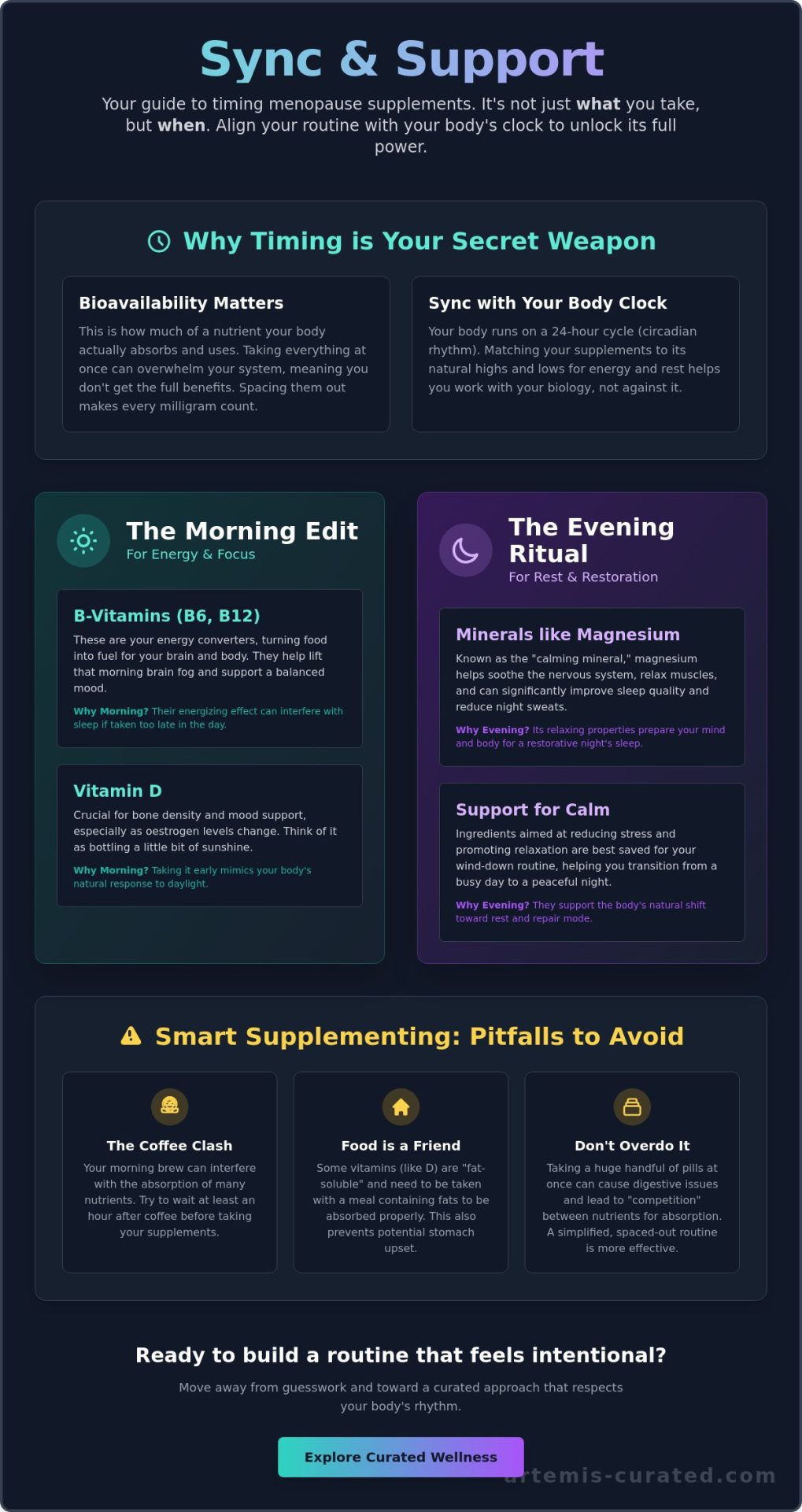
B-vitamins, particularly B12 and B6, are the quiet workers behind your neurotransmitter balance. They help your body convert food into energy and support the production of mood-regulating chemicals like serotonin. Because these vitamins have an energising effect, they’re best used early. Taking them too late in the afternoon can sometimes interfere with your ability to wind down at night. For a deeper look at how to select the right nutrients, you might find our guide on the Best Supplements for Women in 2026 helpful for refining your collection.
Vitamin D: The Morning Sunshine Vitamin
Vitamin D is often called the sunshine vitamin, and taking it in the morning helps mimic the body’s natural response to daylight. It’s vital for maintaining bone density, a key concern during the menopause years when oestrogen levels begin to dip. Some research suggests that taking Vitamin D late in the evening might actually suppress melatonin production, making it harder to drift off. By keeping this nutrient in your morning edit, you support your skeletal health without risking your rest. Pairing it with a breakfast that includes healthy fats will help your body absorb it more efficiently.
If you’re managing low iron levels, the morning is also the ideal time for your dose, provided you keep it away from your morning latte. The tannins in coffee and tea can block iron absorption, essentially wasting the supplement. Instead, try taking it with a glass of water or a small amount of Vitamin C, which encourages uptake. Understanding menopause supplement effectiveness often comes down to these small, deliberate adjustments in how you pair your nutrients with your lifestyle.
Setting the tone for a balanced day can also include botanical support that works with your body’s natural fluctuations. When you’re looking for a way to ground your morning, exploring The art of harmony can help you find that elusive sense of balance. This isn’t about a quick fix; it’s about building a sustainable rhythm that respects your body’s needs from dawn until dusk. By being consistent with the best time of day to take menopause vitamins, you move closer to a life that feels supported and synchronised.
The Evening Ritual: Support for Rest and Restoration
As the light softens and the day begins to settle, your body enters a different phase of its narrative. While the morning was about clarity and energy, the evening is a time for restoration and physical recovery. This shift in focus is exactly why the best time of day to take menopause vitamins for relaxation is in the hours before you sleep. By creating a dedicated wind-down window, you signal to your brain that the frantic pace of the day is over. It’s a moment to embrace a slower rhythm, allowing your nervous system to find its way back to a state of calm.
Magnesium and Sleep Quality
Magnesium is often described as a magic mineral, and for good reason. While some sources focus solely on its benefits for bone health, its true power in the evening lies in its ability to soothe the nervous system and relax tired muscles. Magnesium Glycinate is particularly effective because it’s gentle on the stomach and possesses natural sedative qualities. Taking it roughly 30 to 60 minutes before bed can help reduce that lingering sense of evening anxiety. This practice is a key part of Cortisol: Curating the Rhythm of Inner Harmony, as it helps lower the stress hormones that might otherwise keep you tossing and turning.
Botanicals for Nighttime Comfort
Managing night sweats and hot flushes requires a gentle, consistent approach. Certain fat-soluble nutrients, such as Vitamin E, are often recommended for those seeking relief from nighttime temperature spikes. Because these require healthy fats for proper absorption, taking them with your evening meal is often the most effective strategy. Researching various supplements for perimenopause and menopause shows that timing these nutrients with food ensures they are processed efficiently while you rest.
Botanicals like Valerian and Ashwagandha also play a significant role in our “The art of sleep” philosophy. These traditional herbs work to lower evening cortisol levels, helping you drift into a deeper, more restorative slumber. Consistency is the foundation of any successful evening ritual. When you take these supplements at the same time each night, you help your body anticipate the transition to rest. If you’re looking to build a more supportive nighttime routine, you can find specifically chosen options in our shop that align with this restorative goal. Finding the best time of day to take menopause vitamins isn’t just a logistical choice; it’s an act of kindness toward your future self, ensuring you wake up feeling truly renewed.
Common Pitfalls: Coffee, Food, and Absorption
Even with the most thoughtful intentions, small habits can quietly undermine your progress. We often view our morning coffee as a natural companion to our supplement routine, but this simple pairing can act as a hidden barrier. Understanding the best time of day to take menopause vitamins involves more than just a schedule. It requires a gentle awareness of how different substances interact within your body. By making a few deliberate adjustments to your daily flow, you ensure that your carefully selected nutrients are actually being put to work.
The “With Food” Rule
Your digestive system processes nutrients in two distinct ways. Some are water-soluble, while others are fat-soluble. Vitamins A, D, E, and K fall into the fat-soluble category, meaning they require dietary fats to be absorbed effectively. If you take these on an empty stomach, your body may simply let them pass through without gaining the full benefit. To ensure you’re getting the most out of your routine, try pairing these supplements with a meal that includes healthy fats. A few slices of avocado, a handful of walnuts, or a drizzle of extra virgin olive oil can make a significant difference in how well your body utilizes these pieces of your wellness story.
In contrast, water-soluble vitamins like the B-complex and Vitamin C are more flexible. They don’t require fat for transport, but taking them on a completely empty stomach is often the primary cause of supplement-related nausea. This physical discomfort is a signal that your system is being overwhelmed by a concentrated dose. Spacing these out or taking them with a light snack creates a much more comfortable experience, allowing you to maintain your ritual without the unwanted side effects.
Managing the Coffee Gap
Coffee is a cherished ritual for many, yet it contains tannins and caffeine that can interfere with the uptake of essential minerals. Iron and calcium are particularly sensitive to these compounds. When taken too close to your morning cup, the caffeine can block the pathways these minerals use to enter your bloodstream. To avoid this “caffeine barrier,” we recommend waiting at least 30 to 60 minutes after your coffee before taking your morning vitamins. This short pause allows your body to process the coffee first, clearing the way for your supplements to be absorbed without competition.
It’s also worth noting that certain minerals, like zinc and copper, shouldn’t be taken together in high doses. They often compete for the same absorption sites, which can lead to an imbalance over time. A curated approach to your health is about more than just adding more; it’s about the act of selection and timing. If you want to remove the guesswork and ensure your routine is perfectly balanced, you can explore our Full Curated collection to find a rhythm that feels both effortless and effective. Finding the best time of day to take menopause vitamins is ultimately about creating a sanctuary of health that respects your body’s unique chemistry.
Curating Your Daily Routine with Artemis Curated
Building a routine that truly supports you is an act of deep listening. It’s about moving away from the noise of mass-produced, one-size-fits-all solutions and toward a practice that honors your individual story. We believe that finding the best time of day to take menopause vitamins isn’t just a scientific necessity; it’s a way to reclaim your sense of self during a period of profound change. By selecting each element of your day with purpose, you create a sanctuary of wellbeing that carries you from the first light of morning to the quiet stillness of night. This transition is a narrative of evolution, and every choice you make contributes to a larger sense of physical and emotional ease.
Our collections are designed to work in tandem, mirroring the natural rise and fall of your energy. We reject the frantic pace of traditional retail, choosing instead to focus on the intentionality of each formula. When you use “The art of harmony” to ground your morning and “The art of sleep” to settle your evening, you aren’t just taking supplements. You’re participating in a curated experience that respects the craftsmanship of the body. This approach removes the guesswork from your schedule, allowing you to focus on living well rather than managing a complex checklist of pills.
The Harmony Schedule
Integrating our collections into your existing life should feel effortless. We recommend aligning your morning nutrients with a slow breakfast, ensuring you have the healthy fats needed for absorption. As the sun sets, your focus shifts to restoration. By placing your evening supplements on your bedside table, you turn a health requirement into a restorative ritual. For those seeking a more comprehensive understanding of this lifestyle, our Navigating Menopause: A Curated Guide provides a deeper look at aligning these rituals with your daily life.
Consistency is your greatest ally in this journey. Real change happens slowly, through small, intentional acts repeated day after day. It takes time for the body to find its new rhythm, so be patient as you settle into the best time of day to take menopause vitamins for your specific needs. The goal is a steady, supportive flow of nutrients that never feels like a burden on your system.
Next Steps for Your Wellness Journey
As you begin to adjust your timing, consider keeping a simple journal to track how you feel. Notice the shifts in your energy levels or the newfound depth of your rest when you find that perfect window for your nutrients. If you’re ready to simplify your routine and move toward a more soulful way of living, we invite you to explore the full shop. You’ll find a collection of pieces designed with a profound respect for the artistic process of wellness.
This journey is yours to define, and we’re here to act as a knowledgeable guide along the way. You deserve a routine that feels as refined and purposeful as the life you’ve built. Trust your instincts, listen to your body’s narrative, and embrace the quiet authority of a well-timed routine. We’re here to help you find that perfect balance.
Embrace Your New Daily Rhythm
Navigating midlife is a deeply personal narrative, one that deserves a more intentional approach than a handful of pills taken in a rush. By understanding the best time of day to take menopause vitamins, you shift from mere consumption to a soulful ritual of self-care. Remember that your body’s needs change from dawn until dusk. Keep your energising B-vitamins in the morning and save your calming magnesium for the quiet hours before sleep. These small, deliberate choices ensure your body actually absorbs the support you’re giving it, helping you move through your day with a sense of quiet authority.
We focus on holistic harmony rather than fleeting trends, offering expertly curated collections that respect your body’s natural cycles. Our goal is to help you remove the guesswork so you can focus on the beauty of your everyday life. When you choose to support your internal clock, you’re choosing to live with purpose and grace. Every step you take toward synchronising your routine is a step toward feeling more like yourself again.
Explore the Art of Harmony: Curated Menopause Support
Take this time to listen to what your body is telling you. You deserve a routine that feels as balanced and refined as the life you’ve built. Trust your instincts and enjoy the journey toward a more harmonious version of yourself.
Frequently Asked Questions
Can I take all my menopause vitamins at night if I forget them in the morning?
Taking everything at night isn’t recommended if you’ve missed a morning dose. Certain nutrients, like B-vitamins, have an energising effect that can interfere with your sleep cycle. It’s usually better to simply resume your normal routine the following day. Taking a large amount at once can also overwhelm your digestive system, leading to discomfort rather than the harmony you’re seeking.
Should I take my menopause supplements on an empty stomach?
Most supplements are processed more effectively when taken with food. Fat-soluble vitamins, such as Vitamin D and E, actually require dietary fats to be absorbed into your system. Taking your capsules with a meal also creates a buffer for your stomach lining. This simple step prevents the nausea that often comes from taking concentrated nutrients on an empty stomach.
Does caffeine affect how menopause vitamins work?
Caffeine and tannins can definitely interfere with how your body absorbs specific minerals. Coffee acts as a barrier for iron and calcium, potentially making your supplements less effective. We suggest leaving a gap of at least 30 to 60 minutes between your morning cup and your vitamin ritual. This allows your body to process the caffeine before focus turns to nutrient uptake.
How long does it take for menopause vitamins to start working?
You should expect to wait between 4 and 12 weeks to feel the full benefits of a new supplement routine. While some minerals like magnesium might offer a sense of calm more quickly, vitamins work by gradually building up your body’s stores. Consistency is the most important factor in this journey. It’s about a long-term commitment to your wellbeing rather than a quick fix.
Is it better to take Magnesium in the morning or at night for menopause?
Night is the best time of day to take menopause vitamins like magnesium to support your rest. This mineral helps soothe the nervous system and encourages muscle relaxation, making it a perfect addition to your evening wind-down window. By taking it 30 to 60 minutes before bed, you help your body prepare for a restorative night of deep sleep.
Can I take menopause vitamins alongside HRT?
Supplements can often be used alongside other treatments, but you must consult your doctor or pharmacist before starting. They can provide professional guidance tailored to your medical history and any medications you’re currently taking. While we don’t offer HRT or clinical consultations, we believe in a collaborative approach to health that prioritises your safety and peace of mind.
What should I do if my vitamins make me feel nauseous?
If you feel nauseous, try taking your vitamins with a larger meal instead of a light snack. This physical reaction is often your body’s way of saying the dose is too concentrated for an empty stomach. You might also find relief by spacing your supplements out across the day. This gentle approach respects your digestive boundaries while still providing the support your body needs.