


Did you know that more than two-thirds of women experience cognitive shifts during their menopause transition? It often starts with a misplaced set of keys or a forgotten name during a meeting. You might find yourself staring at a screen, wondering what you were about to type. While these moments can feel frightening, coping with menopause-related memory loss is often about understanding a temporary fuel crisis in the brain rather than a permanent decline. It is a natural part of a significant life shift, not a loss of your intelligence or your essence.
It is completely normal to feel overwhelmed by this sudden fog, or even to worry about your long-term health. We understand that your mind is your most precious sanctuary, and we are here to help you move from fear toward a sense of quiet empowerment. In this guide, you will discover why these hormonal shifts affect your focus and learn gentle, effective strategies to reclaim your cognitive clarity. From practical daily tools to the supportive ritual of our menopause support, The art of harmony, we will explore how to navigate this season with grace. Let’s look at how you can restore your mental rhythm and feel like yourself again.
Key Takeaways
- Understand why these momentary lapses are a temporary biological shift rather than a permanent loss of your focus or identity.
- Learn gentle, everyday strategies for coping with menopause-related memory loss by supporting the parts of the brain most affected by changing hormones.
- Gain the confidence to distinguish between typical midlife forgetfulness and more serious health concerns, replacing fear with understanding.
- Discover how prioritizing deep, restorative rest through The art of sleep helps your mind organize thoughts and store memories with more ease.
- Explore how a mindful approach to nutrition and The art of harmony can create a steady foundation for mental clarity and cognitive rhythm.
Understanding Menopause-Related Memory Loss and Brain Fog
Have you ever stood in the middle of your kitchen, staring at an open cupboard, and realized the reason you walked in there has completely vanished? It’s a disorienting feeling. This experience, often called brain fog, isn’t a single medical condition. Instead, it’s a collection of cognitive shifts that many women encounter during perimenopause and menopause. While it feels like your mind is slowing down, it is actually a sign that your system is undergoing a profound transition. Coping with menopause-related memory loss begins with the realization that you aren’t losing your intelligence; your brain is simply learning to operate under a new set of rules.
It is completely normal to feel a prickle of anxiety when a familiar name slips away or a word remains stubbornly on the tip of the tongue. You might worry that these lapses are a sign of something more serious, but for most, this is a temporary fuel crisis. This period is sometimes clinically referred to as Postmenopausal confusion, a term that captures the temporary haze that can settle over daily life. Validating these feelings is the first step toward reclaiming your confidence. You are not alone in this; your brain is simply asking for a different kind of support as it navigates this change.
The Common Signs You Might Notice
The experience of brain fog is rarely the same for two people, but there are several hallmark signs that many recognize. These moments often feel like a glitch in a normally smooth process. You might notice:
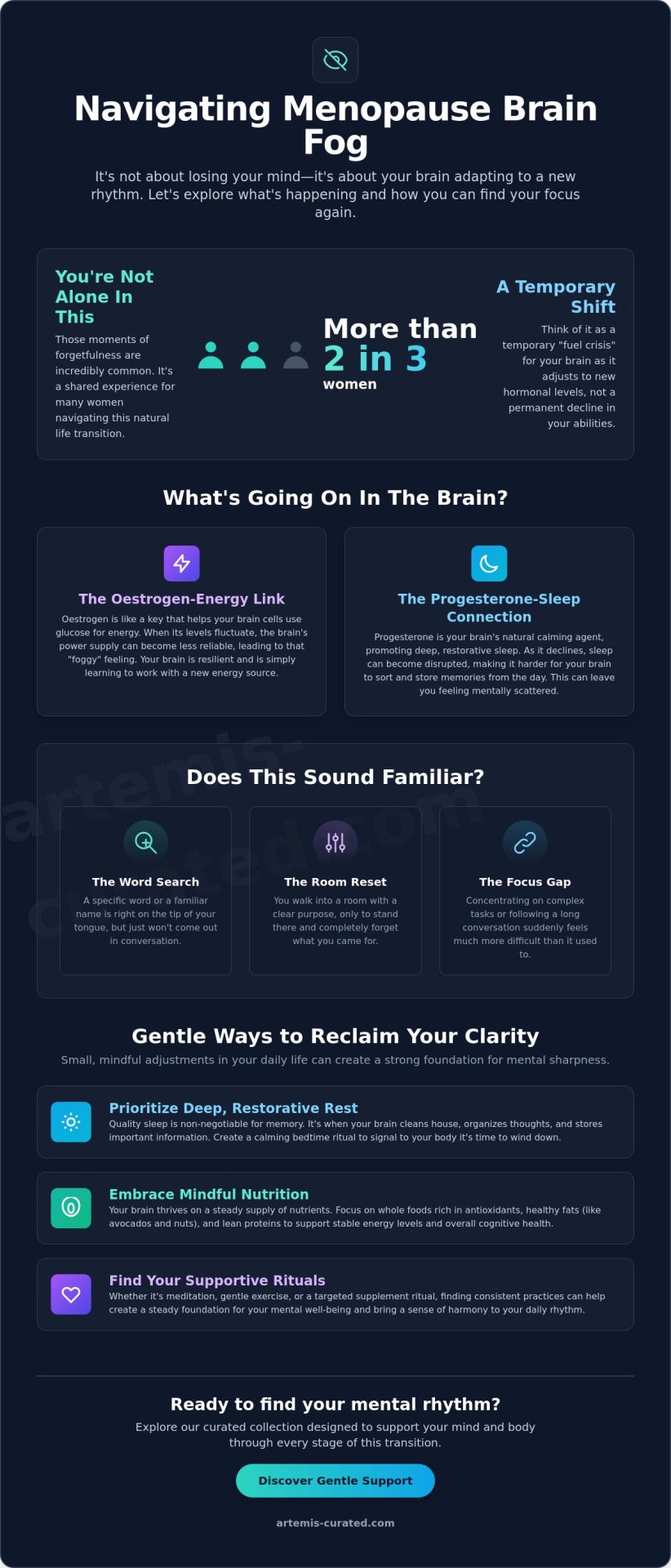
- The Word Search: Names of acquaintances or specific nouns feel just out of reach during a conversation.
- The Room Reset: Entering a room and immediately forgetting the intended task, only to remember it once you sit back down.
- The Focus Gap: Finding it harder to stay concentrated on complex tasks, long documents, or multi-step projects that used to feel effortless.
Why This Happens: The Oestrogen Connection
Oestrogen acts as a vital spark for your brain. It helps your brain cells use glucose for energy, essentially acting as the fuel that keeps the lights on. When oestrogen levels begin to fluctuate and eventually drop, the brain’s usual communication pathways are disrupted. It’s as if the power grid is being upgraded; there are moments of flickering before the new, steady state is reached. Your brain is essentially recalibrating, learning how to maintain focus and store memories with less of its primary hormonal driver. This isn’t a permanent decline, but a season of change where your mind needs a little more patience. You can find gentle ways to support this transition by exploring our Full Curated collection, designed to bring balance back to your daily rhythm.
The Impact of Hormones on Cognitive Clarity
The brain is a remarkably sensitive organ, responding to the subtle shifts in our internal chemistry with profound changes in how we think and feel. At the heart of this transition is the hippocampus, the brain’s primary center for memory and learning. This area is densely packed with oestrogen receptors, making it particularly vulnerable when hormone levels begin their natural decline. When we talk about Menopause and brain fog, we are really discussing a physical shift in how our neural pathways receive and process information. Coping with menopause-related memory loss requires us to look beyond the symptoms and understand the biological symphony playing out beneath the surface.
The Oestrogen-Glucose Link
Oestrogen does more than manage our reproductive health; it is a key player in how our brains utilize glucose for energy. Think of it as a steady hand that ensures the brain’s power supply remains constant. When oestrogen levels fluctuate, that energy supply can become less predictable, leading to those moments where your thoughts feel sluggish or out of reach. It’s helpful to remember that this isn’t a permanent state of being. Your brain is incredibly resilient and eventually learns to adapt to these lower levels, finding a new, quieter equilibrium over time.
While oestrogen manages the energy, progesterone acts as the brain’s natural sedative, promoting a sense of calm and deep, restorative sleep. As progesterone levels drop, many women find themselves tossing and turning, unable to reach the deep stages of rest where memory consolidation happens. When you don’t sleep well, your brain doesn’t have the chance to “file away” the day’s information, which only makes the daytime fog feel more dense and difficult to navigate.
Cortisol and the Rhythm of Focus
Stress adds another layer to this complex picture. During midlife, many of us face a “Cortisol Spike,” where chronic stress keeps our bodies in a state of high alert. This constant demand for resources essentially “steals” energy away from the parts of the brain responsible for higher-level thinking and memory. When your system is focused on survival, it has less room for the nuance of creative thought or the recall of a specific name. Finding ways to lower these cortisol levels is just as important as any nutritional choice. Creating a sense of internal balance allows your mind to return to its natural rhythm of focus. If you are looking for a gentle way to support this balance, you might find that The art of harmony offers the mindful support your body is asking for during this transition.
Distinguishing Menopause Brain Fog from Serious Concerns
When you find yourself staring at a familiar face and the name simply won’t surface, it’s easy for your mind to jump to the most frightening conclusion. For many women, the primary fear isn’t just about being forgetful; it’s the quiet worry that these slips are the earliest whispers of dementia. It is important to pause and breathe here. While the symptoms can feel similar in the moment, the underlying cause of your fog is almost always hormonal rather than a sign of permanent decline. Understanding these differences is a vital part of coping with menopause-related memory loss and reclaiming your peace of mind.
Research suggests that while menopause affects the speed at which we retrieve information, it doesn’t typically destroy the information itself. Experts at the Mayo Clinic explain how menopause cause brain fog as a transitional phase, meaning your brain is working through a period of recalibration. Once your body settles into its new rhythm, many women find that their mental sharpness returns. This is a season of change, not a final destination.
Normal Menopause Forgetfulness vs. Dementia
The main difference lies in how the memory is lost. In menopause, the issue is usually “retrieval.” The memory is stored in your mind, but the path to reach it is temporarily blocked. You might forget a movie title during dinner, only for it to pop into your head while you’re brushing your teeth later that night. In contrast, serious cognitive decline often involves losing the context of the memory entirely. Here are a few ways to tell the difference:
- Menopause: You forget where you put your glasses. Dementia: You forget what glasses are used for.
- Menopause: You lose your train of thought in a meeting but can retrace your steps. Dementia: You struggle to follow or join a conversation at all.
- Menopause: You occasionally miss an appointment but remember it later. Dementia: You experience frequent disorientation in familiar places.
When to Consult a Professional
Even though most brain fog is hormonal, your intuition is a powerful tool. If your memory slips are causing significant distress or interfering with your ability to stay safe, a conversation with your GP is a wise next step. It is also worth checking other factors that can mimic brain fog, such as low iron or B12 levels, which are common during this stage of life. Keeping a simple symptom tracker can provide clear, helpful data for your doctor, showing how your focus fluctuates alongside your cycle or sleep patterns. If you find that your rest is the main culprit behind your daily haze, exploring our Full Curated collection may help you find the gentle support needed to restore your nightly rhythm and daily clarity.
Gentle Rituals and Strategies for Mental Sharpness
While the biological shifts we’ve discussed are significant, your response to them can be a series of small, intentional choices. Coping with menopause-related memory loss is not about a single “fix” but rather about curating a lifestyle that supports your cognitive rhythm. By making conscious adjustments to your daily habits, you can lower the noise of brain fog and allow your natural clarity to resurface. It’s about creating a supportive environment where your mind can thrive despite the hormonal fluctuations.
Feeding the Menopausal Brain
Your brain is one of the most energy-demanding organs in your body. To keep it running smoothly, focus on cognitive allies like Omega-3 fatty acids and antioxidants. These nutrients help protect brain cells and support the communication pathways that oestrogen once managed more effortlessly. Hydration is equally vital; even mild dehydration can make concentration feel like an uphill battle. Try to maintain steady energy levels by choosing whole foods over processed sugars. A sugar crash can often mimic the symptoms of brain fog, leaving you feeling depleted and scattered just when you need to be sharp.
Beyond nutrition, how you manage your mental load matters. We often try to hold everything in our heads, which only adds to the stress. Using simple tools like physical lists, shared calendars, and digital boundaries can act as an external memory bank. Setting a “digital sunset” where you step away from screens an hour before bed helps reduce the mental clutter that often keeps us awake. Mindfulness, even for just five minutes a day, can help lower the cortisol levels we explored earlier, giving your brain the space it needs to focus on the task at hand.
Creating a Sanctuary for Rest
Sleep is when the most important work of memory happens. During deep rest, your brain essentially “cleans” itself, clearing away the metabolic waste of the day and consolidating new information into long-term storage. Without this nightly restoration, the daytime fog becomes nearly impossible to lift. Creating a sanctuary for rest involves more than just a comfortable bed; it’s about the rituals that tell your body it’s safe to let go. Gentle evening routines, such as a warm bath or a few pages of a book, can signal the transition from the day’s demands to deep recovery. For those seeking extra support in reaching those restorative stages, The Art of Sleep is designed to help you drift into the deep rest your mind requires.
If you’re ready to embrace a holistic approach to your wellness, you can explore our Full Curated collection to find the right support for your journey.
Curating Your Path to Cognitive Harmony
Finding your way back to mental clarity isn’t about rushing toward a finish line. It’s a slow, deliberate process of listening to what your body is trying to tell you. Coping with menopause-related memory loss often requires us to look at our health as a whole, rather than as a series of isolated symptoms. By taking a holistic approach, you can create a foundation of support that goes far beyond a simple checklist. This is about more than just remembering where you left your phone; it’s about feeling grounded and capable in your own skin again.
We believe that wellness should be a choice made with deep intentionality. Instead of reaching for a generic, mass-produced solution, consider the value of a carefully selected routine. When you approach your well-being with this level of respect, you aren’t just managing a transition. You are honoring the journey your body has taken over the years. This shift in perspective can turn a period of frustration into one of profound self-discovery. It is about choosing quality over quantity in every aspect of your life.
Support Through Targeted Botanicals
Nature offers a wealth of support for those navigating the hormonal shifts of midlife. Specific botanicals have long been valued for their ability to bridge the gap left by declining oestrogen and progesterone. These ingredients work in harmony with your system to support mental clarity and emotional steadying. When you select a supplement, the quality of the source and the care in its creation matter deeply. Our formula, The Art of Harmony, was designed specifically for this life stage, focusing on ingredients that encourage a sense of internal balance and focus. By choosing supplements with a clear purpose, you transform your daily routine into a supportive ritual that honors your body’s needs.
Final Encouragement: Reclaiming Your Narrative
It’s easy to feel like your story is being interrupted by brain fog, but this phase is actually an invitation to write a new chapter. Be patient with yourself as your brain recalibrates. Some days will feel clearer than others, and that’s okay. Self-compassion is just as important as any nutritional strategy or sleep habit. You are navigating a major life change, and your mind deserves the same grace you’d give to a dear friend. If you feel ready to embrace a more complete approach to your wellness, we invite you to explore our full collection for total support. From deep rest to daily balance, every piece is here to help you find your rhythm and reclaim your confidence.
Reclaiming Your Mental Rhythm
Navigating the shift in your cognitive rhythm is a journey that requires both patience and the right tools. We’ve explored how these momentary lapses are often a sign of your brain recalibrating to new hormone levels rather than a permanent loss of clarity. By prioritizing restorative rest and managing the daily impact of cortisol, you can move through this season with much more ease. Coping with menopause-related memory loss is ultimately about listening to what your body needs and responding with kindness.
Our founders, Milly and Sarah, have carefully curated a collection designed for the discerning woman who values quality and botanical harmony. We believe that supporting your system should feel like a natural extension of your daily life. If you are ready to find your focus again, we invite you to Explore The Art of Harmony for holistic menopause support. This blend is specifically crafted to help you feel grounded and clear as you navigate this transition. You have the strength to reclaim your narrative, and we are here to support every step of that journey. Your clarity is not lost; it is simply waiting for the right rhythm to return.
Frequently Asked Questions
How long does menopausal brain fog usually last?
Brain fog is typically a transitional phase that resolves once your hormone levels settle into their new rhythm. For most women, this period of cognitive recalibration lasts through perimenopause and the early years of postmenopause. It’s not a permanent decline. As your brain adapts to a new equilibrium, you’ll likely find your mental sharpness and focus returning naturally over time.
Can supplements really help with memory loss during menopause?
Targeted botanical support can be a gentle and effective way of coping with menopause-related memory loss. Ingredients that support hormonal balance help bridge the gap while your body adjusts to lower oestrogen levels. Our formula, The art of harmony, is designed to support this specific life stage with intentionality. It’s about providing your system with the right nutrients to maintain mental rhythm and clarity.
Is brain fog a sign that I need HRT?
Brain fog is a common symptom of hormonal shifts, but it doesn’t automatically mean you need medical intervention like Hormone Replacement Therapy. Everyone’s journey is unique and depends on their specific health history. It’s best to discuss your symptoms with a healthcare professional to explore all your options. In the meantime, holistic strategies and lifestyle rituals can offer significant support for your cognitive clarity.
What is the best way to handle memory slips at work?
Managing memory slips in professional settings is often about using practical external memory tools. Don’t be afraid to rely on detailed notes, digital reminders, or shared calendars to lighten your mental load. If a word escapes you during a meeting, a simple “it’s on the tip of my tongue” usually suffices. Most people are understanding when you remain calm and keep the conversation moving.
Are there specific foods that help with menopausal brain fog?
Nutrition plays a vital role in fueling your brain through this transition. Focus on foods rich in Omega-3 fatty acids, like walnuts or flaxseeds, and plenty of colorful antioxidants to protect your neural pathways. Staying hydrated is also crucial for maintaining concentration throughout the afternoon. Avoiding heavy sugar consumption helps you skip the energy crashes that often make cognitive haze feel much more dense.
Does stress make menopause memory loss worse?
Stress is a major contributor to cognitive haze because high cortisol levels can disrupt how your brain retrieves information. When your body is in a state of high alert, it prioritizes survival over the nuance of creative thought or name recall. Finding quiet moments for mindfulness or gentle breathing can help lower these stress markers. Reducing the noise in your life allows your mind to find its focus.
Can lack of sleep cause permanent memory damage during menopause?
Poor sleep doesn’t cause permanent damage, but it definitely prevents your brain from consolidating memories and clearing out mental clutter. Deep rest is when your mind does its most important maintenance work. If you’re struggling to reach those restorative stages, The art of sleep can help you create a better nightly rhythm. Better rest leads directly to better daytime focus and a much clearer head.
Is menopause brain fog the same as dementia?
Menopause brain fog is not the same as dementia. While both involve memory, menopause usually affects the speed of retrieval rather than the existence of the memory itself. You might forget a movie title but remember it later that evening once you’ve relaxed. Dementia involves a more profound loss of context and daily function. If you’re concerned, tracking your symptoms can provide helpful data for your doctor.