

Did you know that by the time you reach 40, your body has already lost approximately 25% of its natural collagen stores? It’s a subtle, unfolding change that often shows up as fine lines or hair that doesn’t feel quite as resilient as it used to. You likely feel that the sheer volume of health trends and complex labels makes it difficult to find a path that truly resonates with your needs.
We believe your wellness routine should be a source of ease rather than confusion. This guide will show you exactly how collagen supports your skin’s elasticity and keeps your joints comfortable as your daily rhythms change. We’ll walk through the different types available in the UK and help you create a simple, effective habit that brings a sense of lasting vitality to your everyday life.
Key Takeaways
- Learn why collagen is the essential foundation for your skin’s structure and how your body naturally produces this vital protein.
- Understand the differences between marine and bovine sources to help you choose the right support for your skin, hair, and joints.
- Compare the pros and cons of liquids, powders, and capsules to find a format that fits easily into your daily routine.
- Identify common “collagen killers” and discover simple lifestyle habits that help protect your body’s natural stores.
- Find out why a steady, consistent approach is more effective for long-term radiance than high-intensity, short-term fixes.
Understanding Collagen: The Foundation of Your Vitality
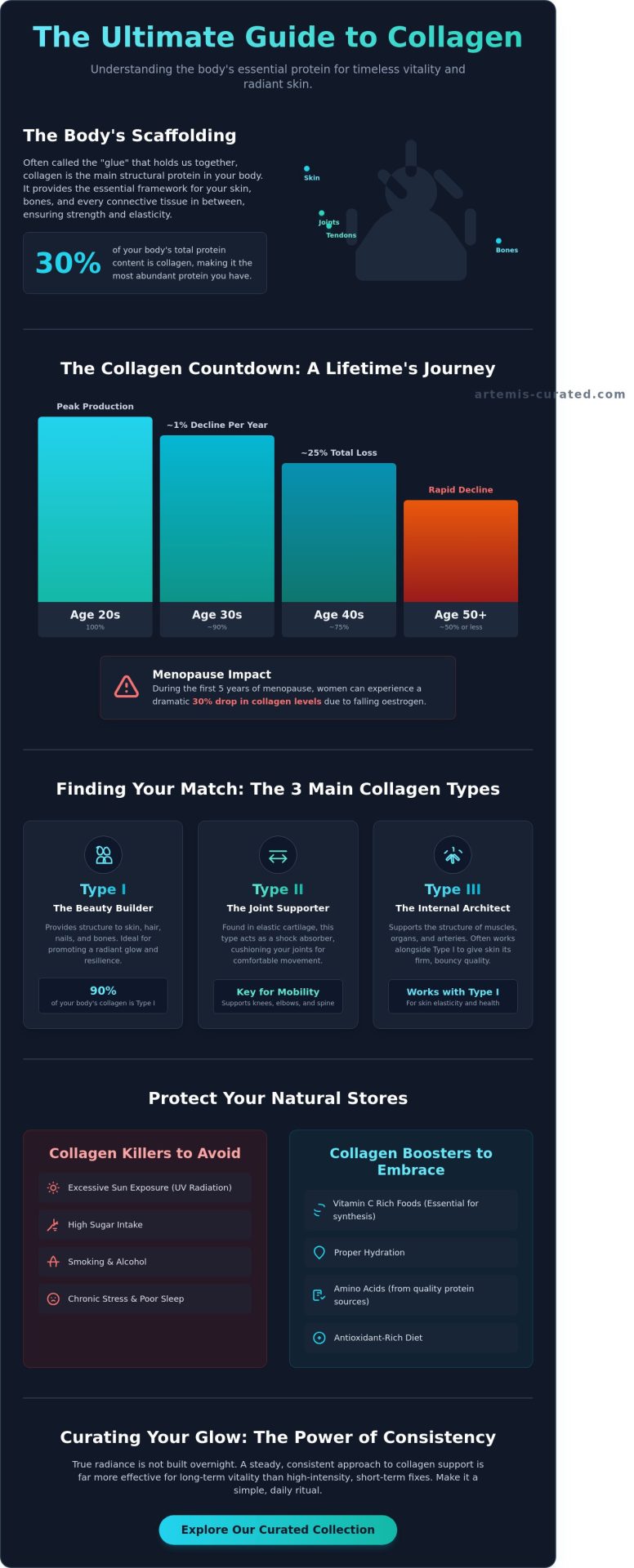
Think of your body as a carefully curated space where every element serves a distinct purpose. At the heart of this internal architecture lies collagen, a substance often described as the biological glue that holds our physical selves together. While many people associate it purely with the surface-level glow of a well-kept complexion, its role is far more profound. It provides the essential scaffolding for your skin, bones, and every connective tissue in between. For women, maintaining this structural integrity is a vital part of long-term health, ensuring the body remains resilient and strong as the years unfold.
We often see it marketed as a simple beauty fix, but it’s a whole-body essential that deserves a more soulful appreciation. It acts as the silent narrator of our physical history, supporting the very frame that allows us to move through the world with ease. You can explore our collection of wellness essentials at the Artemis Curated shop to see how we approach intentional living through quality and care.
What exactly is this protein?
In the simplest terms, this substance is the main structural protein found in the human body. It’s an incredibly sturdy molecule, defined by a triple-helix shape. This design looks much like three individual strands of yarn twisted tightly together to create a single, unbreakable rope. This unique collagen structure gives our tissues their impressive strength and tactile elasticity.
It isn’t just a minor player in our biology. This protein makes up roughly 30% of your body’s total protein content. While you’ll find it almost everywhere, it lives primarily in the dermis layer of your skin, your tendons, and your cartilage. It’s the silent force that keeps your joints moving smoothly and your skin feeling firm to the touch, acting as a bridge between strength and flexibility.
Why our levels change over time
Our bodies are remarkably efficient at producing this protein during our youth. However, this natural production begins a steady decline once we reach our mid-20s. Research indicates we lose about 1% of our natural supply every year after this point. For women, the shift becomes more pronounced during perimenopause and menopause. During the first five years of menopause, women can experience a 30% drop in their levels due to falling oestrogen, which directly impacts the skin’s thickness and bone density.
Spotting the early signs of this change doesn’t require a lab test. You might notice your skin feels slightly less bouncy, or perhaps your knees offer a faint protest when you walk down the stairs. These are just the body’s way of telling its story, signalling that the internal architecture is shifting and may need a more intentional approach to nourishment to maintain its timeless strength. If you want to understand the hormonal shifts driving these changes, a blood test for women’s hormones and vitality can help you decode exactly what your body is communicating.
The Science of Support: How Collagen Works from Within
Think of collagen as the invisible scaffolding that holds your body together. It isn’t just a buzzword; it’s a structural protein that makes up about 30% of the total protein in your body. Deep within the dermis, the thickest layer of your skin, tiny cells called fibroblasts act as a dedicated construction crew. These fibroblasts are the factory for new cells, churning out the proteins that keep your skin firm and your joints moving smoothly. However, research indicates that our natural production begins to slow by roughly 1.5% every year once we hit our 20th birthday.
The magic happens through a complex process called collagen synthesis. To nurture collagen production, your body requires a steady supply of specific amino acids like glycine and proline. When you consume the right nutrients, these fibroblasts get to work, weaving individual strands into a triple helix structure. This triple helix is incredibly strong, providing the tensile strength needed to resist stretching and sagging. It’s a delicate internal dance that requires the right raw materials to stay in rhythm.
Type I, II, or III: Which one do you need?
- Type I: This is the heavy hitter of the group, accounting for 90% of the collagen in your body. It consists of densely packed fibres that provide structure to your skin, hair, nails, and even your bones. If you’re looking for a radiant glow or stronger manicures, this is the type you want to focus on.
- Type II: Found primarily in elastic cartilage, this type is all about the joints. It acts as a shock absorber, providing the cushioning your knees and elbows need to move without discomfort.
- Type III: This type supports the architecture of your muscles, organs, and arteries. It often works alongside Type I to give your skin its elastic, bouncy quality.
The importance of collagen peptides
If you’ve ever looked at a supplement label, you’ve likely seen the term “hydrolysed” mentioned. This is a crucial detail for anyone wanting real results. In its raw state, the collagen molecule is quite large and difficult for the digestive system to break down. Through a process called hydrolysis, these long protein chains are broken into much smaller pieces known as peptides. Hydrolysed collagen is the broken-down form of the protein for optimal absorption.
Size matters here. While raw collagen might have a molecular weight of 300,000 Daltons, peptides are usually reduced to a mere 2,000 to 5,000 Daltons. This small size allows them to pass through the gut wall and enter the bloodstream more efficiently. Once they arrive, these peptides act as biological “signals.” They trick your fibroblasts into thinking there’s a breakdown in the system, which triggers your body to ramp up its own natural production. It’s a clever way to support your body’s longevity from the inside out. You can find a selection of high-quality formulations in our curated shop to support your daily ritual.
Finding Your Match: Marine, Bovine, and Delivery Formats
Selecting a collagen supplement is a personal decision that shapes your daily wellness ritual. It’s more than just a purchase. It’s about finding a source that respects your body and your values. As the most abundant protein in the human body, collagen acts as the scaffolding for your skin, hair, and connective tissues. Deciding which type to bring into your home depends on what you want to achieve.
Marine vs. Bovine: A simple comparison
Marine collagen is frequently the preferred choice for those focusing on skin radiance. Sourced from fish scales and skin, it’s exceptionally high in Type I collagen. The particles are smaller than other sources, which means your body can process them with ease. It’s a refined option for a targeted beauty routine. If you’re looking for something that supports your muscles or gut health, bovine collagen might be a better fit. It provides both Type I and Type III collagen. This source is typically derived from cow hides and is a staple for those with more active lifestyles.
Ethical considerations play a role here too. Marine collagen is often a clever use of byproducts from the fishing industry, reducing waste. When looking at bovine options, always check for grass-fed and pasture-raised certifications. These labels reflect a commitment to quality and animal welfare that aligns with a more conscious way of living.
Liquid, powder, or capsules?
The format you choose should reflect your daily rhythm. Liquid collagen is prized for its convenience. It’s often highly concentrated and ready to drink, though this ease comes at a higher price point. In the UK, premium liquid shots can often cost upwards of £3.50 per daily dose. This might feel like a luxury, but it’s perfect for those with a fast-paced morning. It removes the need for mixing and measuring entirely.
Powder remains the most versatile and popular choice. You can stir it into your morning tea, blend it into a smoothie, or even whisk it into a bowl of porridge. It allows for a higher dosage, usually around 10 to 20 grams per serving, without much effort. It’s often the most cost-effective way to maintain a consistent routine over several months.
Capsules offer a portable alternative for travel. They’re easy to toss into a bag, but they have limitations. You might need to take several capsules to reach the same dosage found in a single scoop of powder. A typical capsule might hold only 500mg. This means you’d need 20 of them to match a standard 10g serving of powder. For a more intentional experience, browse a curated shop to find a format that feels right for your space and your schedule. Choosing with purpose ensures that your wellness journey feels like a natural extension of your life.
Beyond the Supplement: Protecting Your Natural Stores
Adding a daily supplement to your routine is a beautiful gesture of self-care, but it isn’t a total solution. You can’t simply build new foundations while the existing walls are under attack. Protecting your natural protein stores is about creating a lifestyle that respects the delicate biology of your skin. It’s about being intentional with your choices so that the work your supplements do actually lasts. Think of your skin like a heritage building; you can bring in the finest materials, but if you don’t fix the roof, the structure still suffers.
Lifestyle habits that damage your collagen
The environment and our daily choices can be surprisingly harsh on our internal scaffolding. Sun exposure is the primary culprit. Research published in the British Journal of Dermatology suggests that UV radiation is responsible for roughly 80% of visible facial ageing. Even on overcast days in the UK, those rays penetrate the clouds and break down protein fibres. Wearing a broad-spectrum SPF 30 or 50 every morning is the most effective way to keep your skin’s structure intact.
Dietary choices also play a significant role in how your skin feels and looks. High sugar intake leads to a process called glycation. This occurs when sugar molecules attach to proteins, creating brittle fragments known as Advanced Glycation End-products. These fragments make your skin lose its bounce and resilience. Stress is another silent factor. When cortisol levels stay high, it actively inhibits collagen production and accelerates its breakdown. Taking a few moments for quiet reflection or a slow walk can do more for your skin than you might imagine.
The essential nutrient partners
Your body needs a specific set of tools to weave new proteins effectively. You can think of these as the architects of your skin’s health. Without them, the raw materials from your supplement can’t be put to good use. Pairing your collagen routine with top rated women’s vitamins ensures you have the full spectrum of co-factors your body needs to make the most of every dose.
- Vitamin C: This is the non-negotiable partner for skin health. A 2017 study in the journal Nutrients highlighted that vitamin C is essential for the enzymes that stabilise and cross-link protein strands.
- Zinc and Copper: These minerals are vital for the structural integrity of your connective tissues. They help ensure the mesh of your skin remains strong and resilient over time.
- Whole Foods: Complement your routine with red peppers, kale, and pumpkin seeds. These provide the bioavailable co-factors your body craves to maintain its natural strength.
Preserving your natural glow is a holistic journey. It’s about more than just what you ingest; it’s about how you live and the environment you create for yourself. When you protect your stores, you allow your natural beauty to unfold with grace and permanence.
To find the perfect additions for your daily ritual, explore our curated collection.
Curating Your Glow: A Holistic Approach to Radiance
True radiance isn’t found in a single bottle or a fleeting trend. It’s the result of a thoughtful, steady narrative you build for yourself every day. When we talk about wellness, we’re really talking about the quiet choices that add up over time. Integrating collagen into your life works best when you view it as one part of a wider, intentional routine. It’s not about forcing a change overnight; it’s about supporting your body’s natural rhythm with grace and consistency. You don’t need to do everything at once. Small, deliberate actions often carry the most weight.
Focusing on consistency rather than intensity is the secret to lasting results. A 2019 meta-analysis published in the Journal of Drugs in Dermatology showed that daily supplementation for 90 days led to measurable improvements in skin hydration and elasticity. This suggests that the real power lies in the ritual itself. By choosing to support your health through a curated collection of nutrients, you’re honouring the body you live in. It’s a way of moving through the world with a sense of purpose and self-respect.
The Art of Radiance
We see beauty as a composition. Our guide on The Art of Radiance explores how to select elements that work in harmony. Marine collagen is a vital part of this, but it performs best when paired with a supporting cast. For example, Vitamin C acts as a necessary co-factor for synthesis, helping your body process the supplement more effectively. Think of your supplement routine as a daily act of self-care. It’s a quiet moment in your morning to check in with yourself and set a tone of nourishment for the hours ahead.
Building your wellness ritual
Creating a ritual should feel like an invitation, not a chore. You might stir your powder into a warm cup of lemon water each morning or blend it into a calming evening tea. The goal is to make it a seamless part of your environment. Tracking your progress is a wonderful way to stay connected to the journey. You might notice your nails feel stronger after about 30 days, while changes in skin texture or joint comfort often become more apparent around the 12-week mark. Keeping a simple journal of these tactile shifts can be incredibly grounding.
If you’re ready to expand your approach to vitality, we invite you to explore our full shop. We’ve gathered a selection of supports designed for those who value quality and the story behind what they consume. Ageing is a process to be embraced with intentionality. It’s an unfolding of wisdom and character. By choosing your supports with care, you aren’t just maintaining your appearance; you’re investing in the enduring strength of your own unique narrative.
Start Your Journey Toward Lasting Radiance
Nurturing your body is a lifelong practice that evolves as you do. Scientific studies show that our natural levels of collagen begin to drop by about 1.5% every year once we hit our mid-20s, so finding the right support is a smart move for the long run. You’ve seen how protecting your existing stores through daily sun habits is just as vital as choosing a high-quality supplement. Marine sources are particularly effective because they have high bioavailability, which means your body can actually use the nutrients efficiently.
At Artemis Curated, we focus on the specific health needs of women as they navigate different stages of life. Our expertly curated formulations feature premium marine collagen, designed to work in harmony with your body’s natural rhythms. We believe in high-quality ingredients that help you feel your best without any fuss. Whether you’re looking to support your skin’s natural bounce or your overall vitality, making an intentional choice today will help you feel radiant for years to come. Pairing your supplement routine with a deeper understanding of your hormonal health through a women’s blood test guide to hormones and vitality can give you a fuller picture of what your body truly needs. Rounding out your regimen with top rated women’s vitamins ensures every nutritional base is covered as your needs evolve.
Discover The Art of Radiance and begin your journey to a natural glow
Taking this small step today is a wonderful way to look after yourself and embrace the years ahead with confidence.
Frequently Asked Questions
How long does it take for collagen supplements to work?
You’ll typically see visible changes in skin hydration and texture within 4 to 12 weeks of daily use. Joint support often requires a longer commitment, with most clinical studies suggesting 3 to 6 months for noticeable relief. It’s an unfolding process of restoration that rewards patience and consistency. Your body needs this time to integrate the new proteins into its natural narrative.
Can I take collagen while going through menopause?
You can certainly use collagen to support your body during menopause, as it helps counteract the 30% drop in skin protein levels that occurs during the first five years of this transition. This decline happens because oestrogen levels fall, affecting the skin’s structural integrity and thickness. Integrating a high-quality supplement into your daily ritual provides a gentle way to maintain elasticity and bone density during this significant life shift.
Is marine collagen better than bovine collagen for skin?
Marine collagen is generally considered superior for skin health because its smaller peptides allow for 1.5 times more efficient absorption than bovine sources. These Type I fibres closely mirror the structure of human skin, making them a more targeted choice for those seeking a radiant complexion. It’s about the provenance of the source and how its molecular weight influences the final result.
Does heat affect the quality of collagen powder in coffee?
Heat won’t damage your powder, provided your coffee or tea stays below 300°C. Most hot drinks in the UK are served at approximately 80°C, which is well within the safe range for maintaining the protein’s structural integrity. You can stir your supplement into your morning brew without worrying about losing any of its nutritional value or tactile benefits. It remains a stable and effective addition to your morning.
Can I get enough collagen from my diet alone?
It’s difficult for most people to get therapeutic levels of collagen from the modern British diet alone. While bone broth and slow-cooked meats provide some nutrients, a daily supplement offers a precise 10g to 15g dose that’s hard to replicate through standard meals. Choosing a curated supplement ensures you receive a consistent concentration of the specific amino acids your skin and joints require every single day.
What is the best time of day to take my collagen supplement?
The best time to take your supplement is whenever you can be most consistent, as your body absorbs it effectively at any hour. Some people enjoy it as a morning ritual to start the day with intention, while others prefer taking it at night during the body’s natural repair cycle. There’s no scientific evidence suggesting one time is better than another. Just find a moment that fits your personal rhythm and lifestyle.
Are there any side effects to taking collagen daily?
Side effects are rare, though a small number of people, roughly 1% of users, report mild digestive heaviness or a lingering aftertaste. These sensations are usually fleeting and can often be avoided by choosing a high-quality, hydrolysed powder. Most people find the daily ritual entirely seamless. It’s a gentle addition to a well-considered wellness routine that feels both professional and effective.
Is collagen suitable for vegetarians or vegans?
Collagen isn’t suitable for vegetarians or vegans because it’s exclusively sourced from bovine, porcine, or marine origins. If you follow a plant-based lifestyle, you might look for vegan collagen builders instead. These products contain a curated blend of Vitamin C, zinc, and plant-based amino acids. They’re designed to support your body’s own production rather than providing the animal-derived protein directly.