

You wake up at 3:00 AM, the air in the room suddenly feeling too heavy, and wonder where the woman you used to be has gone. It isn’t just the heat; it’s the unexplained surge of anxiety or the way your thoughts seem to drift behind a veil of fog. You are likely searching for how to feel like myself again during perimenopause, but the answers often feel as fragmented as your sleep. You aren’t alone in this. A 2026 study by The Menopause Society recently highlighted that fatigue and irritability are actually the most frequent symptoms women face, often overshadowing the hot flashes we’ve been taught to expect.
It’s exhausting to feel like you’re just going through the motions in a body that feels unfamiliar. You deserve to move through your days with clarity and grace rather than a sense of constant overwhelm. We promise to help you understand why your internal rhythm has shifted and offer gentle, practical ways to reclaim your balance. We’ll look at the science behind these changes and introduce elegant rituals, including the art of harmony, to help you rediscover your sense of self and feel like your true self once more.
Key Takeaways
- Understand that feeling “unplugged” or irritable is a documented part of the perimenopause transition caused by shifting levels of estrogen and progesterone.
- Discover practical strategies for how to feel like myself again during perimenopause by prioritizing restorative sleep to clear brain fog and regulate your mood.
- Learn why an intentional wellness journey focused on quality over quick fixes is the most effective way to restore your internal rhythm.
- Identify the “energy leaks” in your daily schedule and discover how simple, elegant rituals can help you manage stress and reclaim your focus.
- Explore how targeted support like The Art of Harmony can work with your body’s natural narrative to help you find a sense of balance and calm.
Why Do I Feel So Different? Understanding the ‘Not Myself’ Sensation
It starts as a quiet, persistent hum of disconnect. You might find yourself staring at a to-do list that usually feels manageable, yet today it feels like a foreign language. This sensation of being unplugged from your own life is more than just a bad mood. It is a documented psychological experience often called Not Feeling Like Myself (NFLM). For many women, this shift is the very first sign of the transition, appearing long before the more famous symptoms like hot flashes or night sweats. Understanding this is the first step in learning how to feel like myself again during perimenopause.
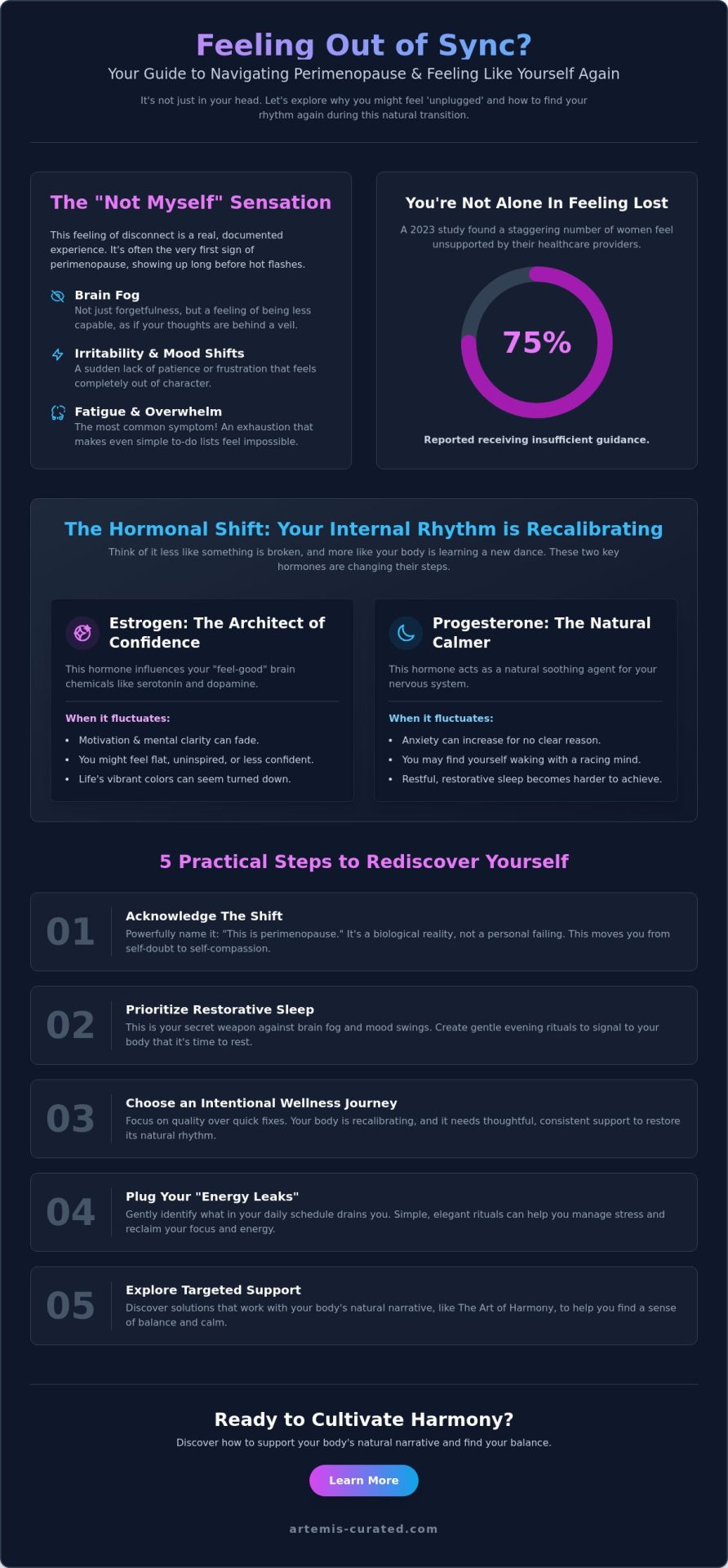
It is incredibly frustrating to have your self-confidence shaken by these vague emotional shifts. You aren’t imagining things, and you aren’t failing. A 2023 study found that nearly 75% of perimenopausal women reported receiving insufficient guidance from their healthcare providers, which only adds to the sense of isolation. By Understanding Perimenopause as a complex hormonal shift rather than a sudden end point, you can begin to see why your internal rhythm feels so out of sync.
Identifying the Signs of a Shifting Identity
Brain fog is one of the most common thieves of identity. It isn’t just forgetfulness; it’s a sense of being less capable than you were yesterday. It can make you feel like you’re languishing, just going through the motions without the joy or spark that usually defines you. This often spills into your relationships. You might feel a sudden irritability with your partner or a lack of patience at work that feels entirely out of character. It’s important to distinguish this perimenopausal meh from clinical depression. While depression is often a deep, persistent heaviness, the perimenopausal shift usually feels like a loss of your usual rhythm and energy. You still want to be your old self, you just don’t know where she went.
The Power of Naming Your Experience
There is immense power in simply saying, “This is perimenopause.” It moves the problem from a personal failing to a biological reality. Instead of asking what’s wrong with you, you can start asking what your body needs. This shift from self-doubt to self-compassion is vital for anyone wondering how to feel like myself again during perimenopause. Naming the experience reduces the anxiety that comes with the unknown. NFLM is a temporary hormonal disruption of your inner rhythm that does not define your permanent state of being.
The Hormonal Shift: Why Your Internal Rhythm Feels Out of Sync
Think of your body as a delicate ecosystem that is currently learning to re-balance its resources. For decades, your system has relied on a steady supply of specific hormones to keep everything running smoothly. During the menopausal transition, that supply becomes unpredictable. This isn’t a sign that something is broken. Instead, it’s a period of recalibration. When you are searching for how to feel like myself again during perimenopause, it helps to understand that your internal “tuning” is simply changing.
Oestrogen: The Architect of Confidence
Oestrogen does so much more than manage your reproductive health. It acts as a vital architect for your brain chemistry, directly influencing how you produce and use serotonin and dopamine. These are the “feel-good” chemicals responsible for your mood, motivation, and mental clarity. As oestrogen levels begin to decline, that familiar sense of inspiration can start to fade. You might feel flat or uninspired, as if the vibrant colors of your life have been turned down to a duller shade. To dive deeper into this connection, you can explore our guide on Oestrogen: Understanding the Architect of Female Vitality. Understanding this link can help you realize that your recent lack of confidence is a biological response, not a personal flaw.
While oestrogen is the architect, progesterone is the stabilizer. It usually acts as a natural “calm” for your nervous system. When progesterone fluctuates or drops, it often leaves the door open for increased anxiety and poor sleep. This is why you might find yourself feeling on edge for no clear reason or waking up in the middle of the night with a racing mind.
The Role of Cortisol and Stress
Midlife often brings a unique set of external pressures, and thanks to the “Cortisol Connection,” these stressors hit much harder than they used to. When your sex hormones are in flux, your body becomes more sensitive to cortisol, the primary stress hormone. High levels of cortisol can actually “steal” the precursors your body needs to produce other hormones, making your symptoms feel even more intense. It’s a cycle where stress feeds the hormonal imbalance, and the imbalance makes you less resilient to stress.
Learning to quiet this response is a major part of how to feel like myself again during perimenopause. You can find more strategies for this in our article on Cortisol: Curating the Rhythm of Inner Harmony. By recognizing these shifts, you can begin to choose support that respects your body’s changing needs. If you’re looking for a gentle way to start that journey, our Full Curated collection offers a thoughtful approach to restoring your sense of balance.
Evaluating Your Support System: Lifestyle vs. Targeted Supplements
Reclaiming your sense of self is rarely about a single, frantic change. It is a slow, deliberate process of selection. When you look for how to feel like myself again during perimenopause, you might be tempted by the loud promises of “quick fixes” found on crowded retail shelves. But your body isn’t a problem to be solved overnight. It’s an evolving story that requires a more thoughtful, curated approach to wellness. Selecting only what your system truly needs is an act of respect for your own history and health. Quality over quantity. Soul over fleeting trends.
Mass-produced multivitamins often lack the specificity needed for this unique window of life. They are built for the average, not the individual. Choosing high-quality, targeted ingredients allows you to address the specific “energy leaks” and emotional shifts we discussed earlier. It is about the quality of the source and the intentionality behind the formula. When you select a supplement with a storied history of use and modern validation, you are doing more than just consuming. You are collecting tools that help you write the next chapter of your life with clarity. This is the difference between mere maintenance and true harmony.
Beyond the Basic Multivitamin
Magnesium is often the missing piece in a support system. It acts as a gentle anchor for the nervous system, helping to quiet the “cortisol hum” and support deeper, more restorative sleep. Botanical extracts, like those found in our carefully selected blends, can also be powerful allies. These plants work with your body’s natural chemistry to nudge your internal hormones back into a state of balance without the jarring effects of synthetic alternatives. You can explore our Best Supplements for Women in 2026 to see how we select ingredients with purpose and respect for the maker’s craft. It is about finding the right note for your unique rhythm.
The Foundation of Lifestyle Rituals
Even the best support needs a solid foundation. Sleep is the ultimate reset for your sense of self. Many symptoms of perimenopause, like brain fog and irritability, are significantly amplified by a lack of rest. Movement should also be intentional. Moving away from frantic, high-intensity workouts in favor of restorative practices like walking or yoga can prevent cortisol spikes that leave you feeling drained. Finally, consider how you fuel your day. Stabilizing your blood sugar by focusing on protein and healthy fats helps prevent the mid-afternoon mood crashes and “hangry” moments that can make you feel so disconnected from your usual, composed self. Small rituals, practiced daily, create the space for you to feel like yourself again.
5 Practical Steps to Rediscover Your Sense of Self
Reclaiming your rhythm isn’t about a grand, sudden overhaul. It is a series of intentional choices that respect your body’s changing needs. When you are searching for how to feel like myself again during perimenopause, these five grounded steps offer a way back to your center. They aren’t meant to be another burden on your to-do list, but rather a set of gentle invitations to reconnect with your own narrative.
- Step 1: Prioritize restorative sleep. Deep rest is the only way to clear the lingering brain fog and regulate the emotional peaks and valleys of your day. Without it, every other challenge feels magnified.
- Step 2: Audit your stress. Take a quiet moment to identify “energy leaks” in your schedule. These are the tasks, habits, or interactions that leave you feeling depleted rather than fulfilled.
- Step 3: Introduce targeted support. Use high-quality, intentional ingredients to bridge the hormonal gaps that lifestyle alone cannot always reach. This is about giving your body the specific resources it needs to find balance.
- Step 4: Reconnect with joy. Find a small activity that once made you feel like “you.” It might be as simple as ten minutes with a sketchpad, listening to a favorite record, or a short walk in the garden.
- Step 5: Track your new rhythm. Your cycle and symptoms are changing. Keeping a simple log helps you anticipate shifts and recognize patterns, turning confusion into a sense of agency.
Creating a Sanctuary for Sleep
Your bedroom should feel like a retreat from the noise of the world. Simple evening rituals, such as dimming the lights or reading a physical book, signal to your brain that the day is done. Keeping the room cool is also essential. A lower ambient temperature can significantly reduce the impact of night sweats, allowing for the deep sleep necessary to feel like yourself the next morning. If rest has become elusive, The Art of Sleep offers a thoughtful way to encourage your body back into a restful state.
Small Rituals, Big Impact
Consistency in small rituals creates a steady foundation for long-term vitality. A ten-minute quiet morning routine, perhaps with a cup of tea before the house wakes up, provides a sense of calm agency over your day. You can use The Art of Harmony as a physical anchor for this practice. It serves as a daily reminder that you are intentionally choosing to support your well-being. These moments of pause are not luxuries. They are the essential building blocks of a life lived with purpose and grace.
Cultivating Harmony: How Artemis Curated Supports Your Journey
Finding your way back to your center doesn’t have to be a solitary path. While the transition can feel isolating, it’s actually an invitation to listen more closely to what your system is asking for. We created The Art of Harmony specifically to answer the question of how to feel like myself again during perimenopause. It isn’t a mass-produced solution designed for the millions. Instead, it’s a carefully selected collection of ingredients that work in tandem with your body’s natural narrative, helping you rediscover the steady rhythm that feels like home. We believe that support should be as unique and storied as the woman receiving it.
Every ingredient we select is chosen with a deep respect for the history and craftsmanship inherent in the natural world. We don’t just see supplements as products; we see them as essential elements of a curated life. By focusing on the quality of the source and the intentionality of the blend, we ensure that our support feels intimate and professional. You aren’t just managing symptoms. You’re reclaiming your vitality through a soulful appreciation for what your body can achieve when it’s properly supported. You don’t have to navigate this transition alone, as there’s a community of knowledge and a collection of tools waiting to help you feel like yourself once more.
The Artemis Philosophy: Quality Over Quantity
Our approach is defined by a tone of quiet authority and refined elegance. We eschew the frantic energy of traditional retail in favor of a serene, almost reverent approach to wellness. This is why we focus on a small, intentional range of products rather than a vast, confusing catalog. We prioritize transparency and craftsmanship in every step of the creation process. Every piece in our collection contributes to a larger personal story of health and harmony. We invite you to view your wellness journey as a collection of mindful choices rather than a series of transactions. It’s about selecting with purpose and moving away from the idea of mere consumption toward a life lived with deep intentionality.
Taking the First Step Toward Balance
The journey toward harmony starts with a single, deliberate decision. You don’t have to fix everything today. Instead, focus on one small change that respects your current energy levels. Whether you need to address the “mood-boosting” gaps with The Art of Harmony or find deep, restorative rest with The Art of Sleep, there is a path forward. Our bundles are designed to help you find the right combination for your specific symptoms, acting as a bridge between your current state and the functional reality of a balanced life. We’re here to act as a mentor for those who seek to surround themselves with support that possesses a distinct voice and a storied past.
When you’re ready to learn how to feel like myself again during perimenopause, we’re here to help you curate your new rhythm. You can explore ‘The Art of Harmony’ and our full curated collection to discover how our focus on the hand of the maker and the soul of the ingredient can transform your daily experience. Take the time to appreciate the journey and the philosophy behind your choices, and you’ll find that balance is not just a goal, but a beautiful way of living.
Embracing Your New Chapter of Harmony
Reclaiming your sense of self isn’t about looking back at who you used to be. It is about moving forward with a deeper, more soulful understanding of what your body needs now. We have explored how shifting hormones can cloud your clarity and why small, intentional rituals like prioritized sleep and stress audits are so vital to your well-being. By choosing support that respects your unique narrative, you can navigate this transition with grace and quiet authority. Each choice you make is a step toward a more balanced, vibrant version of yourself.
Finding how to feel like myself again during perimenopause is a journey of mindful selection. Our collections are expertly formulated for hormonal balance, focusing on high-quality, bioavailable ingredients. Designed by women, for women navigating midlife, they offer the targeted support your system craves during this time of recalibration. You deserve to feel composed, clear, and fully present in your own life once more.
Rediscover your inner harmony with our curated menopause support collection.
You have the power to define this next chapter on your own terms. Trust in the process, listen to your rhythm, and know that a sense of balance and joy is always within reach.
Frequently Asked Questions
Is it normal to feel like a different person during perimenopause?
Yes, it is entirely normal and is a widely documented experience often called “Not Feeling Like Myself.” Fluctuating hormones like estrogen and progesterone directly affect your brain chemistry, which can lead to feelings of disconnect or sudden irritability. You aren’t losing your identity; your system is simply undergoing a significant recalibration. Acknowledging this shift as a biological event rather than a personal failing is a vital first step in your journey back to balance.
How long does the ‘not feeling like myself’ phase of perimenopause last?
The duration varies for every woman, but the perimenopause transition typically lasts between four and ten years. While the sense of disconnect can feel heavy, it usually fluctuates in intensity alongside your hormonal cycles rather than remaining constant. By introducing intentional lifestyle changes and targeted support, many women find they can manage these feelings effectively. It is a season of change, not a permanent state of being, and your rhythm will eventually stabilize.
Can supplements really help me feel more like myself again?
High-quality, targeted supplements can be incredibly effective in helping you bridge the nutritional and hormonal gaps that occur during this time. When you select ingredients with purpose, such as magnesium for the nervous system or specific botanicals for balance, you provide your body with the resources it needs to stabilize. This is a core part of learning how to feel like myself again during perimenopause, as it moves you away from generic fixes toward curated care that respects your body’s narrative.
What are the first signs that I’m entering perimenopause?
The first signs are often emotional or cognitive rather than physical. You might notice a sudden surge in unexplained anxiety, disrupted sleep patterns, or a persistent brain fog that makes daily tasks feel more difficult. These shifts often occur while your periods are still regular. Recognizing these early “energy leaks” allows you to begin supporting your system before more well-known symptoms, such as hot flashes or night sweats, even begin to appear.
How do I talk to my partner or family about not feeling like myself?
Start by being direct and explaining that you are navigating a natural biological transition that affects your mood and energy. Use simple language to describe the “unplugged” feeling, making it clear that your irritability or fatigue isn’t a reflection of your feelings for them. Asking for specific support, like a quiet hour in the morning or help with evening chores, helps them act as partners in your wellness journey rather than confused observers of your change.
What is the best natural way to manage perimenopause mood swings?
The best natural approach is an integrated one that focuses on stabilizing your internal environment. This includes keeping blood sugar steady with protein-rich meals, prioritizing deep sleep, and using gentle movement to manage stress levels. Adding a targeted support like The Art of Harmony can help nudge your hormones back into a state of balance. Consistency in these small, daily rituals creates the foundation you need to navigate how to feel like myself again during perimenopause with grace and clarity.
Can high cortisol make my perimenopause symptoms worse?
High cortisol definitely intensifies perimenopausal symptoms because your body becomes more sensitive to stress as other hormones decline. When you’re constantly in a state of high alert, your system uses up the very resources it needs to maintain hormonal balance. This can lead to more frequent hot flashes and deeper brain fog. Managing stress through intentional pauses and restorative sleep is essential for keeping your symptoms manageable and your mind feeling clear and composed.