

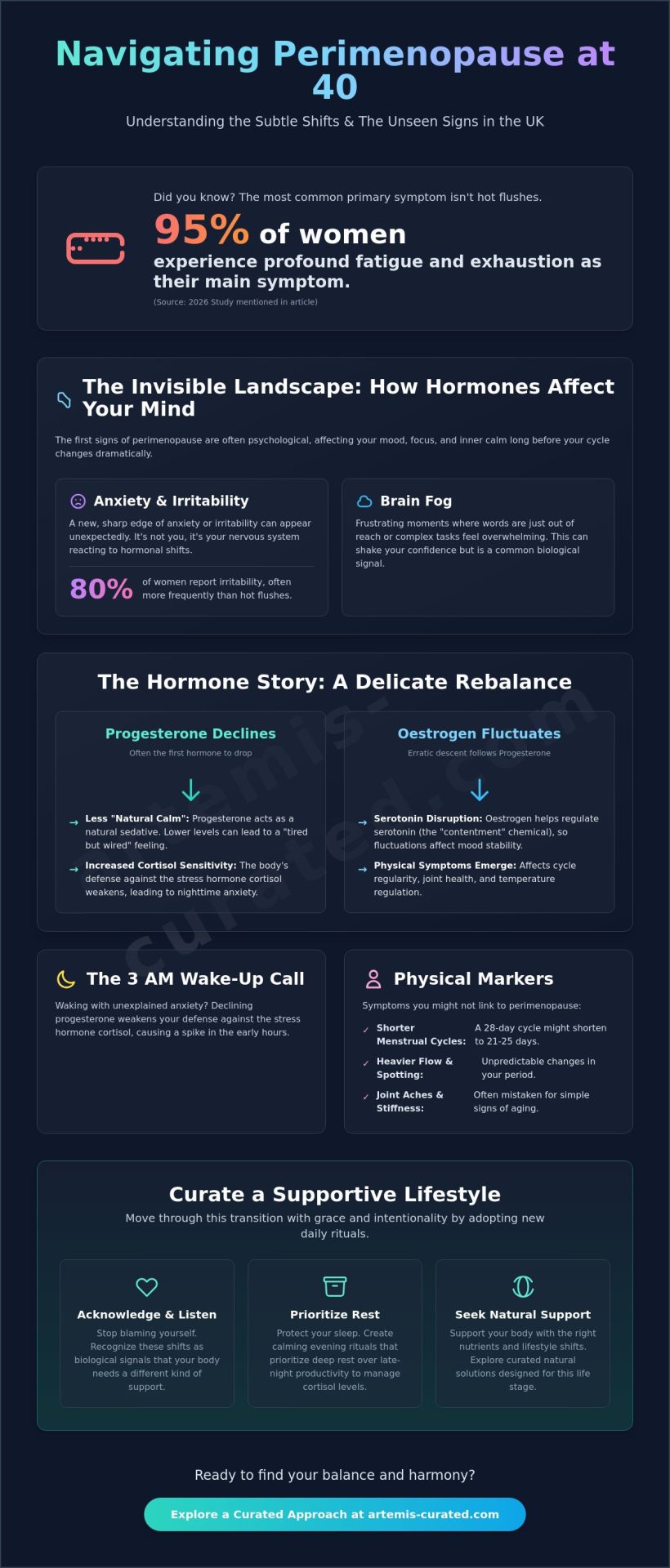
Did you know that while most of us wait for the arrival of hot flushes, a 2026 study found that up to 95% of women actually experience profound fatigue and exhaustion as their primary symptom? If you’ve felt a sudden, heavy cloud of brain fog or noticed your sleep patterns fracturing, you’re likely looking for the common signs of perimenopause at 40 UK to find clarity in the change. It’s a time that can feel unsettling, especially when the symptoms seem invisible to everyone but you.
We understand that this shift isn’t just a clinical milestone; it’s a deeply personal narrative unfolding within your own body. You deserve to feel validated in the knowledge that these experiences are a normal, if challenging, part of your journey. In this guide, we’ll help you identify the subtle early indicators of this transition and show you how to support your system naturally. We’ll look at a clear list of signs and explore how a more intentional, curated approach to your daily rituals can help you regain your sense of balance and radiance.
Key Takeaways
- Learn why the first signs of perimenopause are often psychological, affecting your mood and outlook before your cycle even changes.
- Discover why you might be waking up at 3 AM with unexplained anxiety and how your hormones are influencing your inner calm.
- Identify “invisible” physical symptoms, such as joint aches and stiffness, that are frequently mistaken for simple aging.
- Find out how to spot the early signs of perimenopause at 40 UK so you can start supporting your body with the right nutrients and lifestyle shifts.
- Explore how a curated approach to wellness helps you move through this transition with grace and intentionality.
Noticing the First Signs of Perimenopause at 40
For many of us, the 40th birthday feels like a vibrant peak. You’re balancing a career, perhaps raising a family, and finally feeling settled in your own skin. Then, something shifts. It isn’t a loud disruption, but a quiet, persistent change in your internal rhythm. You might find yourself searching for the signs of perimenopause at 40 UK, wondering if these subtle ripples are part of a larger story. It’s helpful to view perimenopause not as an ending, but as a transitional phase. It’s the prologue to menopause, a time when your body begins a slow, intentional recalibration.
While traditional advice often points to the end of periods as the main event, many women in the UK find their first clues are actually mental or emotional. It’s the sudden, heavy fatigue that doesn’t lift after a good night’s sleep. It’s the brain fog that makes a simple task feel like a complex puzzle. You aren’t just stressed or burnt out by the 40-something juggle. These are often the earliest biological signals that your hormones are starting to fluctuate. Reaching age 40 is a very common time for these shifts to begin, and acknowledging them is the first step toward regaining your balance.
Is 40 Too Early for Perimenopause?
There’s a common misconception that 40 is too young for these changes. In reality, while the average age for menopause in the UK is 51, the perimenopausal transition frequently begins in the early to mid-40s. It’s vital to distinguish this from early menopause, which occurs before age 45. For most, the 40s are simply when the narrative starts to change. Statistics show that symptoms can emerge several years before your final period. Because these signs are so gradual, many women dismiss them as the price of a busy life. Gaining a deeper understanding perimenopause allows you to stop blaming yourself for feeling different and start listening to what your body is asking for.
The Subtle Shift in Your Monthly Rhythm
Even if your periods remain regular, you might notice the tempo of your cycle changing. A cycle that was once a reliable 28 days might contract to 21 or 25 days. You may experience surprise spotting or cycles that feel unusually heavy. These shifts occur because your progesterone levels are beginning to dip, often before oestrogen makes its more dramatic exit. Perimenopause is the body’s natural recalibration of oestrogen and progesterone. Recognizing these signs of perimenopause at 40 UK is the first step toward finding a new, harmonious way of living. If you feel ready to support this transition, you can explore our curated collection of natural supports designed for this specific life stage.
The Invisible Landscape: How Hormones Affect Your Mind
As oestrogen levels begin their slow, erratic descent in your 40s, they often take serotonin along with them. Serotonin is frequently referred to as the chemical of contentment. It’s the stabilizer that keeps your mood steady and your outlook bright. When it fluctuates, your internal landscape can feel suddenly fragile. This is one of the most profound signs of perimenopause at 40 UK that women experience. It isn’t just about feeling a bit down. It’s a fundamental shift in how you process the world around you, where once-simple tasks feel unexpectedly heavy.
You might notice a new, sharp edge of anxiety. It often arrives uninvited during routine tasks or peaks in the quietest hours of the night. This isn’t a reflection of your ability to handle life. It’s your nervous system reacting to a changing chemical environment. A 2026 study found that irritability is reported by 80% of women, often occurring more frequently than the classic hot flush. For many professional women, this is accompanied by brain fog. It’s that frustrating moment when a word sits just out of reach or a complex project feels suddenly overwhelming. It can shake your confidence, but it’s vital to view this as a narrative of the body asking for more stillness and a more intentional way of living.
The 3 AM Wake-Up Call: Sleep and Cortisol
Progesterone is the quiet partner to oestrogen, acting as a natural sedative for the brain. As progesterone levels drop, your body’s defense against cortisol weakens. This creates the “tired but wired” sensation. You’re physically exhausted, yet you’re jolted awake at 3 AM by a spike in stress hormones. Protecting your inner harmony requires a curated evening ritual that prioritizes rest over productivity. If you find your nights are consistently fractured, exploring the art of sleep can help you find a more restful rhythm.
Mood Swings vs. Your True Self
It’s easy to feel like you’re losing your sparkle or becoming someone you don’t recognize. Irritability can flare up over small things, leaving you feeling guilty. These are biological responses, not character flaws. The NHS information on menopause confirms that mood changes are a hallmark of this transition. Approaching these unfolding changes with a soulful sense of self-compassion is essential. Recognizing these mental shifts as early signs of perimenopause at 40 UK allows you to seek the right support sooner. You aren’t losing yourself; you’re simply navigating a natural recalibration.
Physical Markers You Might Not Link to Perimenopause
While we often associate this transition with the sudden heat of a hot flush, the physical narrative often begins with much more subtle changes. You might find yourself waking up with stiff fingers or aching knees, assuming it’s simply the result of a busy lifestyle or a tough gym session. In reality, these are often early signs of perimenopause at 40 UK. Oestrogen acts as a natural anti-inflammatory for our joints. When levels begin to dip, that familiar ease of movement can feel slightly strained, as if the cushioning within your body is slowly thinning.
These “silent” markers aren’t always discussed in the same breath as more famous symptoms, yet they are incredibly common. Beyond joint stiffness, you might notice your skin losing its usual bounce or becoming unexpectedly sensitive to products you’ve used for years. The common signs of perimenopause often include these tactile shifts that affect how you feel in your own skin every day. It’s a reminder that the body is a connected whole, and a change in one area often ripples through the rest. When your physical comfort is compromised, it’s natural for your libido and energy to follow suit, making it harder to feel like your usual, vibrant self.
Skin, Hair, and the Loss of Oestrogen
Oestrogen is the architect of collagen. As it declines, your skin might lose its luminosity, feeling drier and less resilient. You might also notice your hair losing its volume or feeling more brittle than before. This isn’t just about aesthetics; it’s about the health of your largest organ. Supporting your radiance from the inside out becomes essential during this time. You can find targeted support for these changes in our curated collection, which focuses on providing the specific nutrients your body is now requesting.
The Heart and the Heat
One of the more startling symptoms for a woman in her 40s is heart palpitations. That sudden “fluttering” or “thumping” in the chest can be deeply worrying, yet it’s frequently linked to hormonal fluctuations rather than heart health. Similarly, you might experience a subtle internal thermostat glitch before you ever have a full-blown hot flush. You might feel a sudden wave of warmth that passes quickly, or find yourself kicking off the duvet at night. Oestrogen receptors are located throughout the body, affecting everything from heart rate to skin elasticity. Understanding these signs of perimenopause at 40 UK helps you navigate the physical changes with a sense of calm rather than alarm.
Curating a Supportive Lifestyle in Your 40s
Once you recognize the early signs of perimenopause at 40 UK, the focus naturally shifts from observation to action. This life stage isn’t about doing more; it’s about doing better. We advocate for a curated approach to nutrition where quality always takes precedence over quantity. Your nervous system is currently more sensitive to the world around you. Supporting it with magnesium and B vitamins can feel like adding a layer of soft insulation to a frazzled mind. These nutrients act as essential building blocks for the hormones that keep you grounded.
It’s also a time to reconsider how you move your body. While we’ve often been told to push harder, punishing workouts can backfire in your 40s. Intense cardio or heavy lifting when you’re already exhausted can spike cortisol. This is the very hormone causing those 3 AM wake-up calls we discussed earlier. Instead, look for movement that feels restorative. Creating a sanctuary within your home and your body allows for a deeper sense of peace. It’s about intentionality. Every choice, from the food on your plate to the rhythm of your day, should contribute to your sense of harmony.
The Role of Targeted Botanical Support
Sometimes, even a well-curated diet needs a little extra support to bridge the gap to true balance. Natural botanicals like Ashwagandha and Sage have been used for centuries to manage stress and help regulate the body’s internal thermostat. These aren’t quick fixes; they are gentle guides that help your system find its center again. By selecting only what your body truly needs, you avoid the clutter of mass-produced options. To explore a complete approach to these changes, you can view our Full Curated collection for total wellness support.
Rhythm and Ritual: Managing Stress
Managing stress in your 40s requires more than just a holiday; it requires a daily commitment to slow wellness. This means choosing contemplation over frantic action. Simple, intentional rituals, such as a focused breathing practice or a quiet morning tea, can significantly lower your cortisol levels. It’s about finding a rhythm that respects your changing needs. For a deeper look at balancing your system, read our guide on cortisol and inner harmony. Embracing these shifts helps you move through the signs of perimenopause at 40 UK with a renewed sense of vitality.
The Art of Harmony: Finding Your Balance with Artemis Curated
Identifying the signs of perimenopause at 40 UK is the first step in reclaiming your internal tempo. It’s the moment you stop wondering why you feel different and start choosing how you want to live. At Artemis Curated, we believe that this transition is a storied chapter in your personal narrative. It’s an invitation to move away from the frantic noise of generic, mass-produced solutions toward a more intentional way of being. Our flagship support, The Art of Harmony, was created with this exact philosophy in mind. It isn’t just a supplement. It’s a carefully selected blend designed to support your body’s natural recalibration during your 40s.
We approach wellness with the same reverence a collector might show a rare piece of art. This means rejecting the idea of mere consumption in favor of collecting with purpose. Every ingredient we use meets an artisanal standard, chosen for its provenance and its ability to work in harmony with your system. The ingredients aren’t just names on a label; they represent a commitment to efficacy and the hand of the maker. We look for botanical sources that possess a distinct voice and a history of supporting female health. This soulful appreciation for quality ensures that the products you bring into your body are of the highest possible standard. When you choose to curate your health, you’re selecting only what your body truly needs to feel balanced.
A Holistic Approach to Menopause Support
The Art of Harmony focuses on the essential pillars of mood, energy, and hormonal balance. It helps quiet the mental noise and physical discomforts that often emerge during this life stage. If you find your nights are still fractured by those 3 AM wake-ups, our sibling product, The Art of Sleep, offers a gentle path back to rest. You can explore these individual supports or the entire collection at the Artemis shop to find the right fit for your current rhythm. Each piece in our collection is designed to contribute to your larger story of well-being.
Your Journey to Vitality
You are the architect of your own well-being. While noticing the signs of perimenopause at 40 UK can feel like a disruption, these changes are also a request for more focus and care. Living with intentionality means listening to those requests and responding with kindness. We invite you to join the Artemis community for ongoing guidance and support. Your narrative is still unfolding, and it deserves to be a story of vitality, balance, and quiet authority. Surround yourself with the support that reflects the quality of life you seek to maintain.
Embracing Your New Rhythm
You’ve seen that the earliest shifts in your 40s often happen quietly, appearing as a fractured night’s sleep or a sudden cloud of brain fog. These experiences aren’t just signs of a busy life; they’re your body’s way of asking for a more intentional approach to wellness. By recognizing the signs of perimenopause at 40 UK, you can stop feeling at odds with yourself and begin a journey toward a more balanced, harmonious way of living.
At Artemis Curated, we provide a soulful approach to modern wellness that respects your unique journey. Our formulations use expertly curated botanical ingredients designed specifically for the female hormonal narrative. We believe in quality over quantity, ensuring every element in your routine serves a purpose. It’s about moving through this chapter with quiet authority and a deep respect for your body’s changing needs.
Ready to find your center again? Explore The Art of Harmony and rediscover your inner balance. This transition is simply another storied chapter in your life, and with the right support, you can navigate it with confidence and vitality.
Frequently Asked Questions
Can I start perimenopause at 40 if my periods are still regular?
Yes, you can absolutely begin this transition while your monthly cycle remains predictable. Many women find that psychological shifts, such as increased anxiety or a sudden lack of focus, arrive well before any physical changes to their periods. It is quite common for the internal rhythm to shift quietly in the background while the external markers stay the same for a few more years.
What are the most common mental symptoms of perimenopause in your 40s?
The most frequently reported mental symptoms include profound fatigue, irritability, and a sense of “brain fog” that can affect your professional confidence. You might also experience a new, unexplained anxiety that feels untethered to your daily life. These are often the first signs of perimenopause at 40 UK, reflecting how your nervous system is responding to fluctuating hormone levels.
How do I know if it’s perimenopause or just stress?
Distinguishing between the two can be difficult, but perimenopause often brings “invisible” physical symptoms alongside the mental ones. If your feelings of overwhelm are accompanied by night sweats, joint stiffness, or a shorter cycle, it’s likely a hormonal shift rather than just a busy schedule. Tracking your symptoms over a few months can help you see a pattern that relates to your biological rhythm.
Is it safe to take supplements for perimenopause at 40?
For most women, high-quality natural supplements are a safe and supportive way to find balance during this life stage. It’s important to choose products with expertly curated ingredients that work in harmony with your body’s natural processes. Focusing on targeted botanicals like Ashwagandha or Sage can help manage stress and internal temperature without the need for more intensive interventions.
How long do perimenopause symptoms typically last?
The perimenopausal transition is a long-term narrative that typically lasts about four years, though for some women, it can span up to a decade. Because this is a gradual recalibration of your system, the symptoms may wax and wane over time. Finding a sustainable, intentional routine is the best way to support your body through this unfolding journey.
Do I need a blood test to prove I’m in perimenopause at 40?
In the UK, NICE guidelines suggest that for women between the ages of 40 and 45, a blood test to check follicle-stimulating hormone (FSH) levels can be considered to help confirm a diagnosis. However, for many, the diagnosis is based on a soulful look at your symptoms and personal history. Your own lived experience is often the most accurate guide to what is happening within your body.
What are the best natural ways to manage night sweats?
Managing night sweats naturally involves creating a sanctuary for sleep and using gentle botanical support. Sage is highly regarded for its ability to help regulate the body’s thermostat, while avoiding triggers like alcohol or spicy foods in the evening can make a significant difference. Choosing breathable, natural fabrics for your bedding also helps maintain a more harmonious temperature throughout the night.
Can perimenopause cause weight gain around the stomach in your 40s?
Yes, declining oestrogen levels often cause the body to redistribute fat, frequently centering it around the abdomen. This is one of the physical signs of perimenopause at 40 UK that many women find frustrating. Rather than turning to punishing diets, this shift is best managed with a curated approach to nutrition and gentle, restorative movement that doesn’t spike your stress hormones.